
 EN
EN
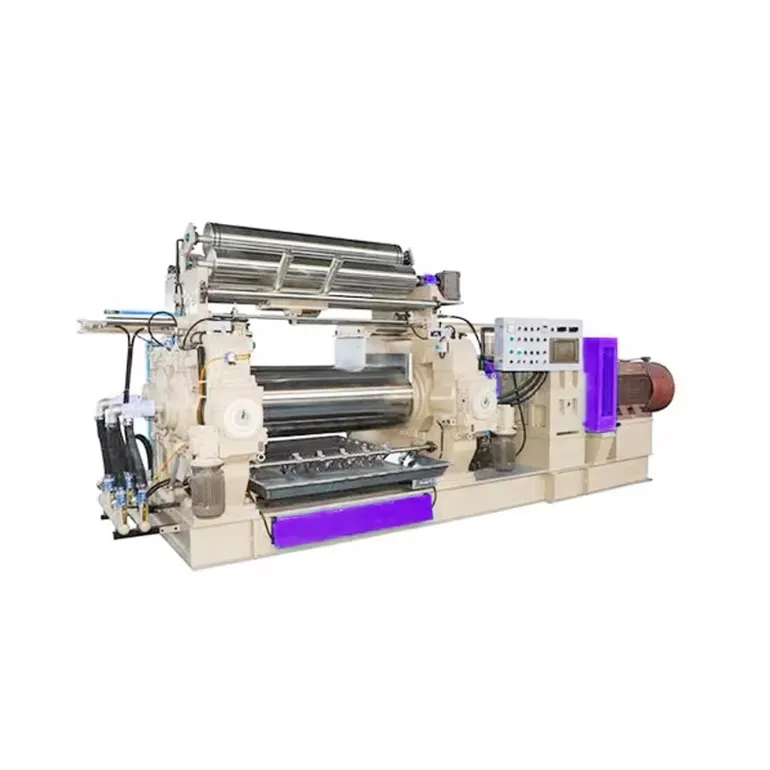
Understanding Rubber Plasticization and the Role of Mixing Mills
What Is Rubber Plasticization and Why It Matters in Compounding
When we talk about rubber plasticization, what we're really doing is taking those stubborn raw rubber polymers and turning them into something that can actually be worked with during production. The magic happens when we reduce those strong forces holding the polymer chains together. What this does is bring down what's called the glass transition temperature, basically making the material soft enough to shape and mold during manufacturing processes. Most manufacturers will add somewhere between 15 to 35 parts per hundred rubber worth of plasticizers. This addition makes their compounds significantly more flexible, sometimes as much as 40%, without sacrificing the tensile strength that's so important for things like tire treads, seals, and all sorts of industrial belts where both durability and flexibility matter equally.
How Mixing Mills Facilitate Efficient Rubber Plasticization
Modern mixing mills achieve homogeneous plasticization through mechanical shear and controlled thermal exposure. Counter-rotating rollers generate shear rates of 1,500–2,500 s-1, effectively dispersing additives while maintaining temperatures between 110°C and 160°C. This range prevents premature vulcanization, particularly important when processing heat-sensitive synthetic rubbers like nitrile or chloroprene.
Key Quality Metrics: Mooney Viscosity and Plasticity Standards
Industry standards require compounded rubber to meet precise plasticity thresholds:
- Mooney viscosity (ML 1+4): ≤65 MU for extrusion-grade compounds (ASTM D1646)
- Williams plasticity: 3.0–4.0 mm recovery after compression (ISO 7323)
These metrics directly correlate with performance in calendaring and molding operations; deviations ≥10% indicate inadequate plasticization or poor filler dispersion.
Core Design Features of High-Productivity Mixing Mills
Advanced rotor designs and their impact on mixing efficiency
The latest mixing mill technology incorporates rotor shapes designed to spread shear forces evenly across materials while keeping power usage down. Manufacturers have started using spiral flight patterns where the angle changes along the length, which actually boosts how much material gets mixed around by about 30 to 40 percent over older models. The surfaces of these rotors are also contoured specifically to create just the right amount of turbulence needed so everything mixes thoroughly including those hard to blend fillers and chemical additives. For companies working with synthetic rubbers, this means each batch takes roughly 15 to 20 minutes less time to process through the plasticization stage. That kind of time saving adds up significantly when looking at production schedules across multiple batches throughout the day.
Precision control of roller gap and temperature for optimal output
High-resolution servo systems maintain roller gaps within ±0.05 mm, essential for achieving target Mooney viscosity values (40–60 MU). Integrated heating and cooling jackets regulate temperature gradients to ±2°C across the chamber, preventing scorching in sensitive compounds such as nitrile rubber. These controls improve batch consistency by 25% and reduce material waste.
Material flow dynamics and shear rate optimization in mixing mills
Computational fluid dynamics informs chamber designs that sustain optimal shear rates of 10–50 s⁻¹ throughout mixing. Angled baffles and flow diverters eliminate dead zones, ensuring 98% of material participates in each rotation cycle. This approach achieves uniform carbon black dispersion with ≤5% variation between batches.
Innovations in mill construction for durability and throughput
Bimetal rollers with tungsten-carbide coatings endure over 8,000 operating hours in abrasive silica-filled compounds. Modular frames allow rapid component replacement, cutting maintenance downtime by 60% compared to welded structures. Dual-drive systems synchronize roller speeds up to 45 RPM while maintaining consistent torque during continuous production runs exceeding 24 hours.
The Rubber Mixing Process: From Raw Materials to Homogeneous Compound
Step-by-step workflow in open mixing mill operations
Rubber mixing starts when workers get the base polymer just right for working with it later on. Most plants have strict protocols about how much of what goes into the mix next step. Carbon black and plasticizers are added according to carefully planned schedules, though experienced technicians often tweak things based on what they see happening in front of them. The actual mixing happens between counter rotating rollers spinning around 15 to maybe 25 times per minute. These machines create just enough heat through friction, and operators can adjust the space between rollers from about 3 millimeters all the way up to 8 if needed. Keeping temperatures somewhere between 60 and 90 degrees Celsius is really important because too hot causes problems with vulcanization before it should happen, but too cold means the polymers won't break down properly. Getting this balance right makes sure everything blends together evenly at the end.
Plasticizing natural rubber vs. synthetic rubbers (e.g., nitrile)
Natural rubber requires extended mastication at 65–80°C to disrupt crystalline domains, whereas synthetic rubbers like nitrile demand tighter thermal control (70–95°C) to activate plasticizers without degradation. While synthetics reach target plasticity 25% faster, they require more rigorous viscosity monitoring during compounding due to their sensitivity to overheating.
Factors influencing plasticization efficiency in continuous production
Efficiency in continuous production depends on feed rates, roller surface patterns, and cooling performance. Automated viscosity sensors adjust shear rates in real time, maintaining Mooney viscosity within ±3 MU across long runs. Roller alignment is crucial—deviations beyond 0.05 mm can reduce mixing uniformity by up to 18% in high-output environments.
Optimizing Mixing Efficiency and Reducing Cycle Time
Identifying Bottlenecks and Measuring Mixing Efficiency
Material feed inconsistencies and uneven heat distribution account for 34% of efficiency losses in rubber plasticization (Polymer Processing Journal 2023). Advanced mills employ torque sensors and infrared spectroscopy to assess dispersion quality in real time, with top-tier systems achieving <2% viscosity variance across batches. Effective bottleneck detection includes:
- Monitoring motor load fluctuations
- Analyzing filler distribution via electron microscopy post-process
- Comparing actual cycle times against theoretical maxima
Strategies to Shorten Cycle Time Without Sacrificing Quality
Plasticization phases are reduced by 18–22% using simultaneous thermal-mechanical processing, where tightly controlled roller gaps (≤0.1 mm variance) accelerate polymer chain alignment. A 2024 Manufacturing Execution System study demonstrated that digital workflow integration cut cycle times by 26% in tire compound production while maintaining strict Mooney viscosity standards (ML 1+4 @ 100°C = 55±2).
Case Study: Productivity Improvements in Industrial Mixing Mills
A synthetic rubber manufacturer increased throughput by 41% after retrofitting their mixing mill with:
- Variable-frequency drives for instantaneous speed adjustments
- AI-powered batch consistency predictors
- Self-clearing rotor geometries
Post-upgrade results showed a 19-second reduction in cycle time and a 14% decrease in thermal degradation compared to conventional systems.
Balancing Speed and Uniformity in High-Speed Mixing Applications
High-shear mixing (>120 rpm) demands precise management of viscoelastic forces to avoid filler agglomeration. Optimal performance is achieved through:
- Helical rotor patterns that minimize dead zones
- Adaptive cooling zones maintaining ±1.5°C across rollers
- Real-time plasticity feedback loops that dynamically adjust nip gaps
Technology Integration in Modern Rubber Mixing Mills
Automation and Real-Time Process Monitoring in Mixing Equipment
Modern mixing mills now come equipped with IoT sensors that keep track of temperature changes, measure how thick the material gets, and detect shear forces while plastics are being processed. Market research from last year shows some impressive results too these sensor systems cut down on quality issues around 40 percent and actually increase production rates by about 18%. The real game changer though is those live dashboards operators get access to. They show exactly what's happening inside the mill at any given moment, so technicians can tweak roller speeds or adjust gap widths without guesswork. This kind of instant feedback really cuts down on mistakes that happen when people try to manage everything manually in such busy manufacturing environments.
Digital Twins and Predictive Maintenance for Uptime Maximization
Digital twins—virtual replicas of physical mills—allow manufacturers to simulate wear and optimize maintenance scheduling. Case studies show a 65% reduction in unplanned downtime when predictive models guide part replacements. In mills processing abrasive compounds like silica-filled SBR, this approach extends gearbox lifespan by 2–3 years.
Energy-Efficient Trends in Next-Generation Mixing Mill Systems
Next-gen systems recover up to 85% of waste heat for reuse in pre-warming materials or facility heating. Variable-frequency drives lower idle-phase energy consumption by 30–35% compared to fixed-speed motors, supporting compliance with ISO 50001 energy management standards. These advancements reduce annual CO₂ emissions by 120–150 metric tons per production line.
FAQ Section
What is the role of plasticizers in rubber compounding?
Plasticizers are added to rubber compounds to reduce the glass transition temperature of raw rubber, making it soft enough to shape during manufacturing processes, and improving flexibility without sacrificing tensile strength.
How do mixing mills improve rubber plasticization?
Mixing mills achieve homogeneous plasticization by generating mechanical shear and controlled thermal exposure through counter-rotating rollers, dispersing additives effectively while maintaining optimal temperatures to prevent premature vulcanization.
Why is precision control of roller gap and temperature important in mixing mills?
Precision control is crucial for achieving the desired Mooney viscosity and maintaining batch consistency, preventing scorching in sensitive compounds, and reducing material waste.
What are digital twins, and how do they benefit mixing mill operations?
Digital twins are virtual replicas of physical mills used to simulate wear and optimize maintenance scheduling, reducing unplanned downtime and extending component lifespan.
Table of Contents
- Understanding Rubber Plasticization and the Role of Mixing Mills
- Core Design Features of High-Productivity Mixing Mills
- The Rubber Mixing Process: From Raw Materials to Homogeneous Compound
- Optimizing Mixing Efficiency and Reducing Cycle Time
- Technology Integration in Modern Rubber Mixing Mills
- FAQ Section