
 EN
EN
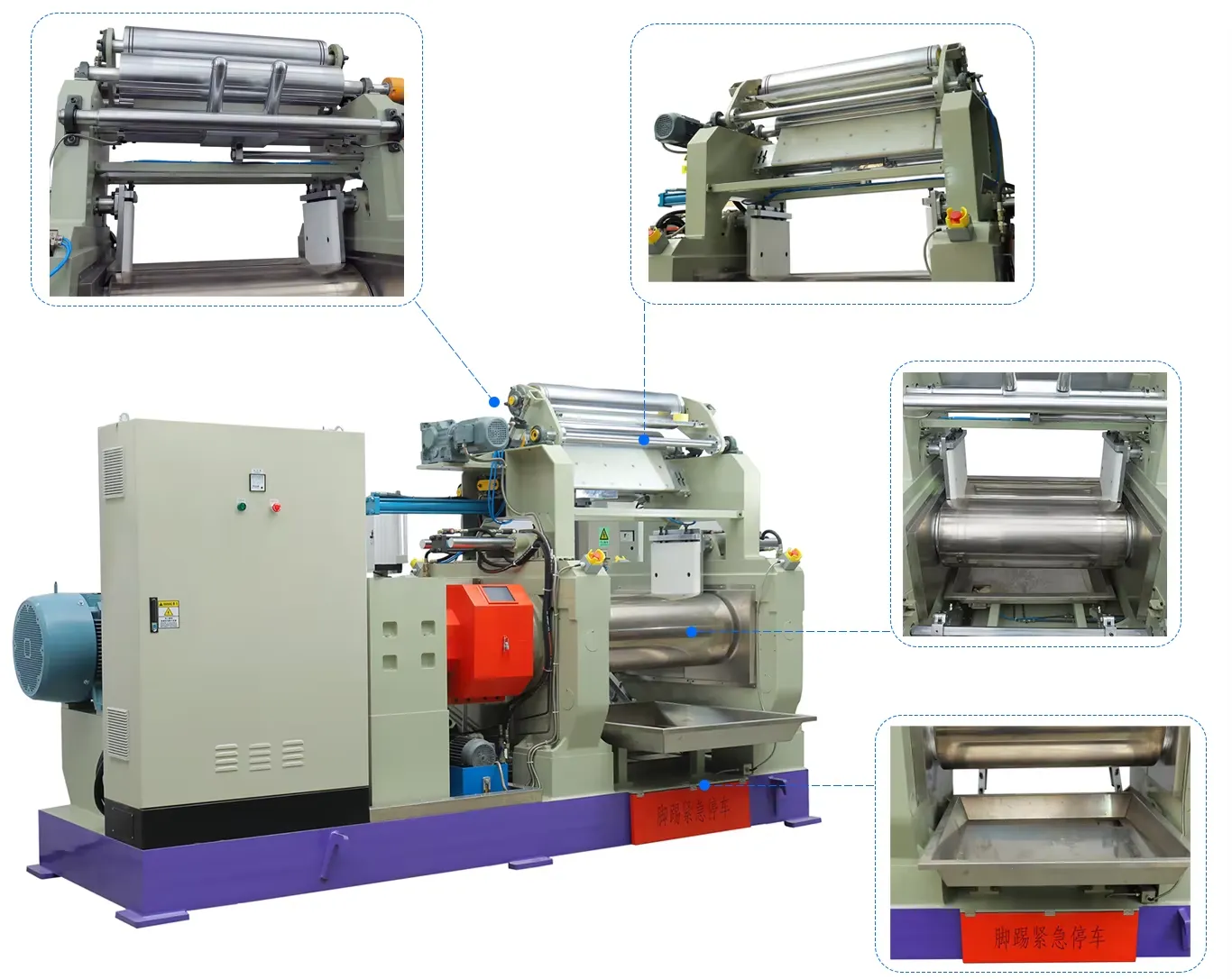
Advanced Roller System Design and Shear Optimization About Mixing Mill
Three-roll mill configuration and roller function in high-shear mixing
Three roll mills today are designed with progressively tighter gaps between rolls ranging from about 5 to 50 micrometers. They also employ counter rotating speeds that can push shear rates way beyond 10,000 per second. Let's break it down: the feed roller typically runs between 5 and 15 revolutions per minute to pull in those thick, sticky materials. Meanwhile, the apron roller spins much faster, anywhere from 50 to 300 RPM, which helps get the processed material out efficiently. What makes this setup special is how the different speeds create what we call a shear gradient. This gradient ends up being roughly 30 percent steeper compared to traditional twin roll systems, and that makes all the difference when it comes to refining materials to their best possible quality.
Roll speed control and friction ratio for precision shear adjustment
Independent servo drives enable 0.1 RPM resolution in roll speed control, allowing precise friction ratios from 1:1.2 to 1:3.5. A 2022 study on polymer nanocomposites demonstrated that a 3:1 middle-to-apron roller speed ratio reduces agglomerate sizes by 58% compared to uniform speeds, significantly improving dispersion without sacrificing throughput.
Roll surface finish (matte vs mirror) and its effect on material flow
Mirror-finished rollers (Ra ¢¤ 0.05 μm) reduce material adhesion by 40% in silicone processing but limit interfacial shear. In contrast, matte-textured surfaces (Ra 0.2–0.5 μm) increase residence time by 22% through enhanced friction, which is essential for achieving sub-5 μm particle distributions in ceramic pastes.
High-speed vs controlled-speed systems: performance trade-offs in mixing mills
High-speed configurations (¢¥200 RPM apron rollers) reduce cycle times by 70% but introduce ±12% batch variability in nanomaterial dispersion. Controlled-speed systems (¢¤100 RPM) maintain ±3% viscosity consistency due to minimal heat generation (<5°C drift per cycle), albeit with 15% longer processing times.
Precision Gap Control and Uniformity in Material Homogenization
Adjustable Roller Gap and Micron-Level Parallelism for Consistent Blending
Motorized micrometer adjustments and laser alignment ensure ±5 µm gap consistency across the rolls, preventing material bypass and ensuring uniform shear distribution. Integrated thermal control systems counteract thermal expansion, which can cause up to 15 µm drift in standard mills, maintaining precision throughout operation.
Impact of Gap Precision on Dispersion Quality in Viscous Materials
When working with materials that have viscosities over 50,000 centipoise, getting those gaps below 10 micrometers really matters if we want enough shear force to break apart nanoparticles. Recent research from 2023 showed something interesting about this. They tested silver pastes with particle sizes around 20 nanometers and found that when they used an 8 micrometer gap, about 92% of the particle clusters broke apart. But when they went up to 15 micrometers, that number dropped down to just 67%. These super tight clearances make a big difference in production consistency too. Manufacturers report that keeping gaps this small helps maintain viscosity differences between batches at or below 2% for both epoxy and silicone products, which is pretty impressive considering how sensitive these materials can be.
Roller Material Customization for Application-Specific Performance
Roll Material Options: Stainless Steel, Alumina, Silicon Carbide, and Zirconia
When choosing rollers for industrial applications, several factors come into play including how resistant they are to wear, their ability to handle heat, compatibility with chemicals, and overall hardness. For most everyday uses, stainless steel with a Rockwell hardness between 50 and 55 works just fine. Alumina is another good option when dealing specifically with pigments or ceramic materials since it has a Vickers hardness ranging from 1500 to 1700. If the process involves really abrasive substances such as battery paste formulations, silicon carbide becomes the material of choice thanks to its impressive hardness rating of around 2500 to 2800 on the Vickers scale. Zirconia stands out in situations where temperature fluctuations matter because it expands very little when heated, making it particularly suitable for working with delicate nano-dispersions that require stable conditions throughout processing.
| Material | Hardness (HV) | Thermal Conductivity (W/m·K) | Best For |
|---|---|---|---|
| Stainless Steel | 200-300 | 16-24 | General polymers, low-shear mixing |
| Alumina | 1500-1700 | 30-35 | Pigments, ceramic precursors |
| Silicon Carbide | 2500-2800 | 120-150 | Abrasive pastes, metal powders |
| Zirconia | 1200-1400 | 2-3 | Pharmaceutical nanoemulsions |
Matching Roller Hardness and Durability to High-Viscosity or Abrasive Materials
Zirconia rollers withstand shear forces over 10ⳠPa in high-viscosity epoxies, while alumina’s fracture toughness (5.2 MPa·√m) resists chipping during pigment grinding. For abrasive graphite pastes, silicon carbide reduces wear by 60% versus stainless steel, lowering annual replacement costs by $18,000 in continuous operations.
Case Study: Ceramic Rollers in Abrasive Paste Processing
Guangdong CFine Technology Co., Ltd. transitioned from hardened steel to alumina-zirconia composite rollers for solar cell silver paste production. Service intervals increased by 40% (from 320 to 450 hours), throughput improved by 15%, and particle contamination dropped below 0.1%, all while maintaining 98% dispersion uniformity.
Thermal Management and Process Stability in Mixing Mills
Integrated Roll Heating and Cooling for Temperature-Sensitive Formulations
Closed-loop cooling and dynamic heating systems maintain ±2°C thermal stability, enabling precise control between 50–80°C for polymer compounding. These integrated thermal controls reduce batch rejects by 34% in silicone production compared to passive cooling, particularly in high-shear zones where overheating risks are greatest.
| Thermal Control Method | Ideal Material Type | Temperature Range | Viscosity Tolerance |
|---|---|---|---|
| Water-Cooled Rollers | High-Viscosity Elastomers | 30–60°C | 200,000–500,000 cP |
| Steam-Heated Rollers | Thermoplastic Blends | 90–140°C | 10,000–50,000 cP |
Preventing Caking and Clumping Through Thermal Stability
Real-time infrared monitoring detects hotspots and automatically adjusts coolant flow to maintain uniform roller temperatures. Keeping temperature variation under 5°C across roller zones improves dispersion homogeneity by 27% in nano-composite mixing and eliminates the 12–18% material loss typically caused by caking in pigment applications.
Scalability, Efficiency, and Industrial Applications of Mixing Mills
Scaling Batch Capacity Through Roll Size and Motor Power Adjustments
Larger roll diameters—up to 450 mm—paired with motors exceeding 75 kW allow scalable processing. Tripling roll diameter increases batch capacity ninefold while preserving shear uniformity. For abrasive ceramic pastes, tungsten carbide rollers operating at 100–200 RPM balance high throughput with consistent dispersion quality.
Continuous Feeding and Discharge Systems for High-Throughput Operations
Automated feeding systems maintain constant input at throughputs up to 200 kg/hour, reducing cycle times by 40% in ink production and minimizing air entrapment in silicone adhesives. Dual-stage discharge blades achieve 99.8% evacuation efficiency, crucial for high-value nano-particle slurries.
Key Applications in Coatings, Inks, Composites, and Nano-Dispersion Technologies
Around the world, the coatings industry handles about 28 million metric tons each year through mixing mills, mainly because people want better automotive clearcoats and those low-VOC paints everyone's talking about these days. These days, mixing mills with zirconia rollers can get down to around 50 nanometers for particle distribution in battery electrode slurries. Meanwhile, folks making stuff for airplanes need really tight control over their processes too. They typically work with plus or minus 2 micrometers gap control to keep things uniform when working with those carbon fiber epoxy composites. The precision matters a lot for quality end products across different sectors.
FAQ
1. What are the benefits of using a three-roll mill configuration?
Three-roll mill configurations offer enhanced shear gradients and efficiency in material refinement compared to traditional twin roll systems.
2. How does roll surface finish affect material processing?
Mirror-finished rollers reduce material adhesion, while matte finishes increase residence time, essential for achieving specific particle distributions.
3. What impact does roller gap precision have on material dispersion?
Tight roller gaps below 10 micrometers are crucial for breaking apart nanoparticles in viscous materials, significantly impacting dispersion quality.
4. Why is thermal stability important in mixing mills?
Thermal stability prevents overheating, improves dispersion homogeneity, and reduces material loss due to caking, enhancing overall process efficiency.
Table of Contents
- Advanced Roller System Design and Shear Optimization About Mixing Mill
- Precision Gap Control and Uniformity in Material Homogenization
- Roller Material Customization for Application-Specific Performance
- Roll Material Options: Stainless Steel, Alumina, Silicon Carbide, and Zirconia
- Matching Roller Hardness and Durability to High-Viscosity or Abrasive Materials
- Case Study: Ceramic Rollers in Abrasive Paste Processing
- Thermal Management and Process Stability in Mixing Mills
- Scalability, Efficiency, and Industrial Applications of Mixing Mills
- FAQ