
 EN
EN
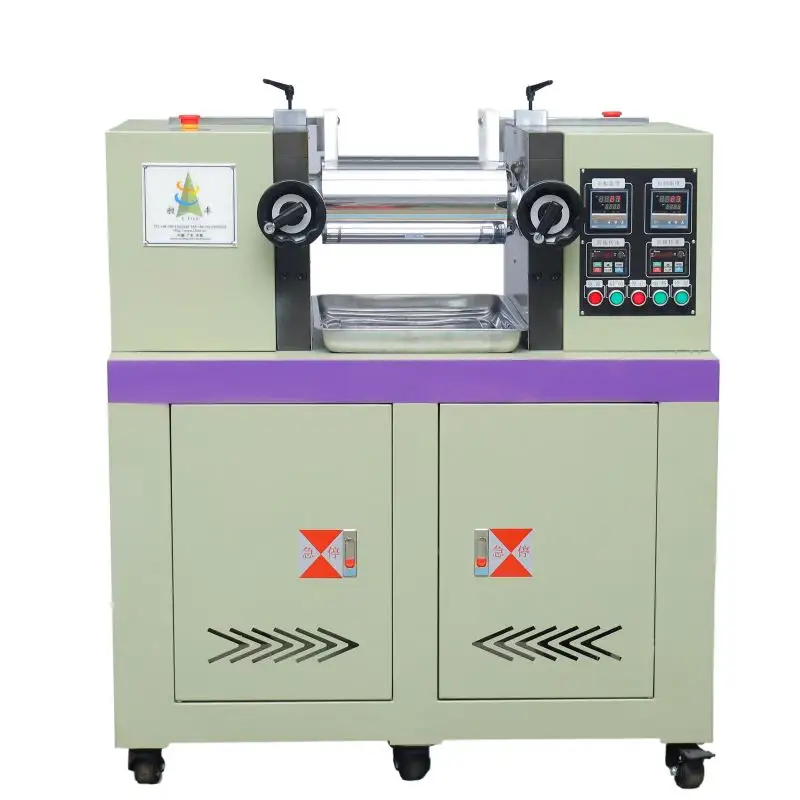
How Open Mixing Mills Work: Design and Core Mechanics
Principle: Core Mechanics of Two-Roll Open Mixing Mill Structure
An open mixing mill basically has two steel rolls positioned side by side, spinning at slightly different speeds. These speed differences create shear forces thanks to a friction ratio usually somewhere around 1 to 1.2 or even up to 1.4. As materials pass between these rolls through what's called the nip gap which can be adjusted anywhere from about 0.3 millimeters all the way up to 10 mm the material gets stretched out and folded repeatedly. This helps mix additives evenly throughout polymers. The front roll spins at a slower pace, generally under 15 meters per minute, so workers can handle things safely without worrying about material slipping off unexpectedly. Industry data shows these machines typically reach between 92 and 97 percent efficiency when dispersing fillers in rubber compounds according to Plastics Technology from 2021. Still, no matter how good the machine is, skilled operators are absolutely necessary if we want consistently homogeneous results across batches.
Trend: Advancements in Open Mixing Mill Materials and Bearings
The latest generation of mills now features hardened steel rollers coated with plasma technology, which cuts down on wear by about 40% when dealing with tough mixing tasks such as incorporating silica into materials. For the bearings, manufacturers have switched to hybrid ceramic options that can handle much greater torque forces reaching around 12 kN m without overheating. These components stay stable temperature wise too, fluctuating no more than plus or minus 3 degrees Celsius even after running non stop for long periods. Putting all these improvements together has led to significant savings in power usage actually cutting energy needs by roughly 18% when compared against what was possible with equipment from just a few years back according to tests run on real world industrial mixing operations.
Case Study: Design Evolution in Industrial Rubber Compounding Mills
In 2023, a complete overhaul was done on an old mill dating back to the 1950s. The upgrade included installing newer gear reducers along with automated systems for adjusting nips during operation. These changes cut down the time needed for each batch from 22 minutes all the way down to just 14 minutes. After looking at what happened after these improvements were made, there was a noticeable 31 percent boost in how evenly torque was distributed throughout the process. Plus, they saw about 18 fewer instances where carbon black clumped together than before. Similar findings come from studies on making things more efficient when mixing materials. For example, companies producing tire treads found that when they added integrated stock blenders into their workflow, workers had to step in manually around 67 percent less often. This not only makes everything run smoother but also creates safer working conditions overall.
Key Process Parameters Influencing Mixing Uniformity and Stability
Principle: Role of Temperature, Time, and Roller Clearance in Compound Development
Getting good results from rubber compounds depends heavily on three main factors: temperature usually around 160 to 180 degrees Celsius for most types, mixing time which typically ranges between five and fifteen minutes, and roller clearance measurements from about 0.3 to 2.0 millimeters. Recent research published last year in polymer processing showed something interesting. When temperatures deviate just plus or minus five degrees, this can actually make viscosity variations jump up by nearly a quarter. And if the rolls aren't set properly, filler distribution gets messed up too, dropping efficiency by over a third according to the same study. What happens when we tighten those clearances? Well, it does create better shear forces during mixing, but there's a catch. Heat sensitive materials like fluoroelastomers start to show signs of scorching much sooner under these conditions, so manufacturers really need to watch their parameters closely throughout production runs.
Phenomenon: Thermal Variability During Open Mill Mixing
The friction during processing creates temperature differences along the roll surface that can hit around 18 degrees Celsius, which messes up the crosslinking process in those sulfur-based compounds. Things get really problematic when the air gets too humid, above 60% relative humidity actually, because batches start getting rejected at alarming rates sometimes as high as 40%. This happens mainly because moisture interferes with how things cure properly, according to research published in Polymer Engineering & Science last year. Factory workers have learned to handle this issue by using what they call sequential feeding techniques where they wait until all the base materials and fillers mix thoroughly before adding any accelerators into the mix.
Case Study: Effect of Roller Temperature Control on Silicone Rubber Mixing
A silicone gasket manufacturer implemented dual-zone roll temperature control (65±2°C on the front roll, 70±2°C on the back roll), reducing viscosity variations by 70%. This precision allowed stable incorporation of fumed silica—a filler prone to agglomeration above 75°C—and cut post-mixing refinement time from 45 to 12 minutes per batch.
Strategy: Establishing Optimal Mixing Windows Based on Material Type
Mixing parameters must be tailored to each material’s rheology:
| Material | Temperature Range | Roll Speed Ratio | Key Additive Window |
|---|---|---|---|
| EPDM | 140–160°C | 1:1.2 | Carbon black @ 120s |
| Silicone | 60–80°C | 1:1.1 | Pt catalyst @ 240s |
| Nitrile | 90–110°C | 1:1.3 | Plasticizers first stage |
Recent advancements in real-time viscosity tracking now enable dynamic adjustments within these windows, improving batch-to-batch consistency.
Optimizing Roll Gap (Nip) and Shear Force for Consistent Dispersion
Principle: Shear Force Generation and Its Relationship to Roll Clearance
The shear force comes about when there's a speed difference between the rolls and whatever adjustment happens at the nip gap. When manufacturers reduce this gap just 0.1 mm, they actually boost shear stress somewhere around 18 to 22 percent. That makes a big difference for getting those particulate fillers dispersed properly throughout materials like carbon black or silica. But watch out if the gap gets smaller than 0.5 mm because thermally sensitive polymers start running into overheating problems. Finding that sweet spot where shear intensity works well without causing heat issues becomes absolutely critical in production settings.
Phenomenon: Non-Uniform Shear Zones Across the Mill Nip
Shear distribution within the nip follows a parabolic profile, peaking at the center and tapering toward the edges. As a result, central regions achieve 97–99% homogeneity, while edge zones reach only 85–88%. Operators often compensate with multiple passes, which improves blending but extends cycle times by 15–20%.
Industry Paradox: High Shear vs. Polymer Degradation Risk
High shear definitely helps with dispersion, but when natural rubber stays exposed too long, it starts breaking down the polymer chains. This actually lowers Mooney viscosity by around 8 to 12 points once it hits over 100 degrees Celsius for about ten minutes straight. Some recent research from polymer engineers in 2024 found something interesting though. When they kept the shear temperatures between 70 and 75 degrees instead, most of the molecular weight stayed intact at about 94%, yet they still got pretty good dispersion at 95%. So there's really a sweet spot here where manufacturers can process materials without sacrificing quality.
Strategy: Balancing Rotational Speed and Dwell Time for Ideal Shear
Advanced mills utilize electronic gap adjustment systems to dynamically optimize shear conditions. For EPDM compounds, a roll speed ratio of 1:1.25 combined with 35–45 seconds of dwell time delivers 92–94% homogeneity without exceeding thermal limits. Real-time viscosity sensors further refine these parameters, reducing batch variability by 30–40%.
Achieving Homogenization: Ingredient Addition Sequence and Mixing Techniques
Principle: Staged Addition Logic in Rubber Mixing Process
Adding ingredients in sequence cuts down blending time somewhere between 12 to 18 percent and leads to better overall consistency. When working with open mills, it makes sense to begin with the base polymer so there's some initial mastication happening before bringing in those solid fillers. The liquid stuff such as plasticizers should come at the end because if they go in too early, they can actually lubricate the rolls and cause unwanted slippage during processing. Following this step-by-step method aligns each mixing stage with what the material needs at that moment, which helps maintain proper shear forces throughout the entire working area of the mill.
Phenomenon: Agglomeration Risks with Improper Ingredient Feeding
Adding powdered additives such as sulfur or accelerators too early increases agglomerate formation by 25% (Ponemon, 2023). These clusters act as stress concentrators, potentially reducing tensile strength by up to 30%. Additionally, premature introduction of temperature-sensitive ingredients during high-friction phases leads to degradation, altering cure behavior and compromising product performance.
Case Study: Silica and Coupling Agent Addition in Green Tire Formulations
A green tire producer improved silica dispersion by 40% through revised sequencing:
- Premastication of base elastomer (2 minutes)
- Silica incorporation at 40–50°C
- Delayed addition of coupling agent in final phase
This change reduced compound hysteresis by 18% while maintaining extrusion-ready viscosity, directly benefiting fuel efficiency in finished tires.
Strategy: Operator Techniques for Maximizing Ingredient Integration
Experienced operators perform cross-blading every 6–8 sheet passes to counteract inherent shear gradients and promote lateral homogenization. When available, real-time torque monitoring identifies plateaus in energy absorption, signaling completion of additive incorporation. This insight enables timely adjustments to feed rate or cooling protocols, preventing over-mixing and thermal damage.
Ensuring Stable Output: Real-Time Monitoring and Quality Control
Principle: Defining Homogeneity and Its Impact on Final Product Performance
When we talk about homogeneity in rubber production, we're basically looking at how evenly those additives spread through the material. This matters a lot because it affects things like how stretchy the rubber is, how long it lasts, and whether it can handle repeated stress without breaking down. Keeping temperatures stable around +/- 1.5 degrees Celsius while mixing makes a real difference. According to MedTech Intelligence from last year, this kind of temperature control boosts compound consistency by nearly a third. These days most factories check for proper mixing with special sensors that measure viscosity on the fly, plus they use infrared tech to spot inconsistencies. If these monitoring systems detect anything off by more than 5%, they'll tweak either the roller speed or spacing automatically to get everything back on track.
Controversy Analysis: Trade-offs Between Mixing Speed and Compound Stability
Faster mixing increases throughput but elevates risks: a 15% speed increase raises shear-induced degradation by 22% (Ponemon, 2023). This trade-off is especially critical in heat-sensitive applications like silicone rubber manufacturing, where productivity gains may compromise material integrity if not carefully managed.
Strategy: Implementing Real-Time Monitoring for Output Stability
Leading facilities deploy integrated monitoring systems that track seven key parameters:
- Temperature variance across rolls
- Real-time torque fluctuations
- Compound viscosity profiles
A 2023 analysis of industrial compounding processes found that plants using IoT-enabled monitoring reduced batch rejection rates by 27% through predictive adjustments. Advanced systems can auto-calibrate roll gaps upon detecting dispersion anomalies, achieving less than 0.8% output variation across extended production runs.
FAQ Section
What is the role of shear force in open mixing mills?
Shear force is generated by the speed difference between the rolls and the nip gap adjustment. It helps in dispersing particulate fillers evenly in materials like carbon black, but it needs to be optimized to prevent overheating sensitive polymers.
How do advancements in materials and bearings impact mill efficiency?
Advancements like hardened steel rollers with plasma coatings and hybrid ceramic bearings reduce wear, manage higher torque, and result in significant energy savings, enhancing mill efficiency.
Why is temperature control crucial during open mill mixing?
Temperature control is vital as it influences crosslinking in compounds, affects viscosity, and ensures stable conditions that lead to consistent product quality.
How does ingredient addition sequencing improve mixing?
Sequencing the addition of ingredients optimizes shear distribution, minimizes blending time, and ensures better uniformity. Adding temperature-sensitive ingredients at incorrect stages can lead to agglomeration or degradation.
Table of Contents
- How Open Mixing Mills Work: Design and Core Mechanics
- Key Process Parameters Influencing Mixing Uniformity and Stability
- Optimizing Roll Gap (Nip) and Shear Force for Consistent Dispersion
- Achieving Homogenization: Ingredient Addition Sequence and Mixing Techniques
- Ensuring Stable Output: Real-Time Monitoring and Quality Control
- FAQ Section