
 EN
EN
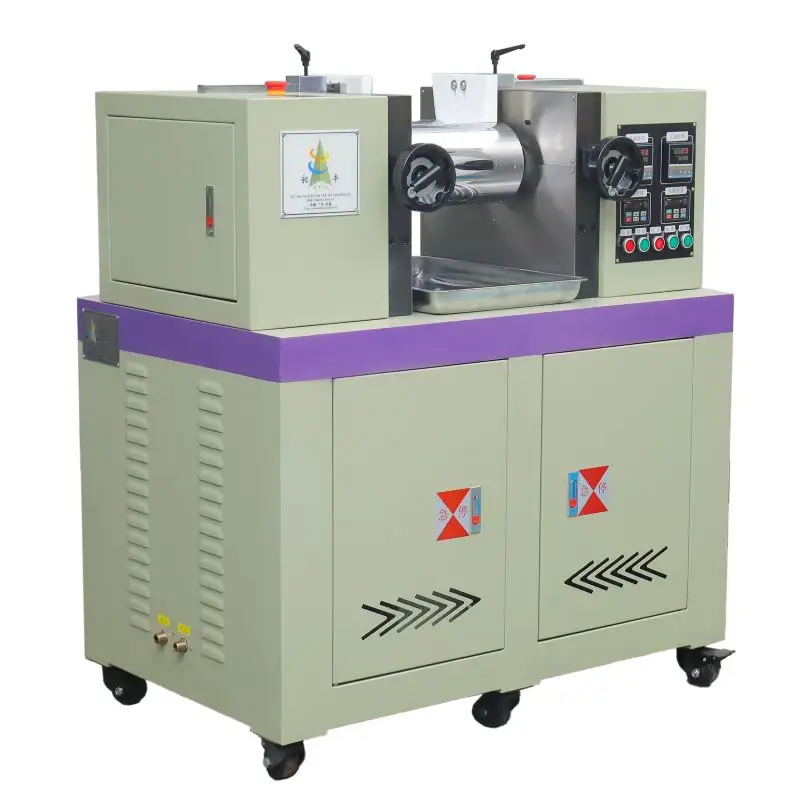
Understanding the Role of Mixing Mills in Polymer Processing
The significance of open mixing mills in rubber and plastic processing workflows
Open mixing mills play a key role in making polymers, letting manufacturers blend materials just right for those industries that demand top notch quality standards. Around 70 percent of rubber compounding work happens on these machines, especially in tire factories and shops producing specialized rubber products. What sets them apart from closed systems? Well, operators can actually see what's happening during mixing and tweak things manually as needed. This matters a lot when working with heat sensitive plastics or recycled stuff that doesn't always flow consistently through the machine. The ability to spot problems early makes all the difference in getting good results.
Achieving consistent material homogenization with mixing mill technology
Uniform dispersion is achieved through controlled shear forces between counter-rotating rolls. By optimizing friction ratios (typically 1:1.1 to 1:1.4) and maintaining roll temperatures between 50â80°C, operators can achieve viscosity consistency within ±2%. This precision prevents filler agglomeration in rubber batches and ensures even color distribution in PVC sheets, minimizing product rejections.
Overcoming batch mixing challenges through reliable open mill solutions
Modern mills address traditional limitations with features that enhance efficiency and safety:
- Wear-resistant roll surfaces reduce contamination risks by 40%
- Digital torque monitoring prevents motor overloads during high-load mixing
- Quick-release mechanisms enable formula changes 50% faster than legacy models
These improvements support batch turnaround times under 72 hours, even when switching between specialty silicones and EPDM compounds.
Core Engineering Design of Double Roll Open Mixing Mills
Modern mixing mill performance hinges on four engineering pillars: structural integrity, precision adjustment, shear optimization, and surface engineering.
Anatomy of a Durable Open Mixing Mill: Frame, Rolls, Drive System, and Safety Features
The foundation for reliable operation lies in the frames made from hardened alloy steel that can handle well over 500 metric tons of radial force without failing. These machines feature dual chilled cast iron rolls, which come in sizes ranging between 8 and 24 inches across. The rolls spin thanks to hardened gear drives connected to powerful motors putting out anywhere from 75 to 150 kilowatts of power to maintain consistent torque during operation. When it comes to safety measures, manufacturers have implemented emergency braking systems along with infrared light curtains around the equipment. This makes sense when we consider the industry reports showing about a 9.1 percent annual incident rate specifically in polymer processing settings where such machinery operates regularly.
Precision in Nip Adjustment and Roll Alignment for Optimal Performance
Roll parallelism within 0.002 inches/mm eliminates thickness variation, while hydraulic nip adjustment allows 0.1mm resolution for compound-specific settings. Proper alignment extends roll service life by 40% compared to misaligned units, according to a 2023 PolymerTech Journal study.
Friction Ratio and Roll Gap Control: Enhancing Shear and Dispersion Efficiency
A typical friction ratio of 1:1.25 to 1:1.5 generates directional shear exceeding 500,000 Paâsufficient for nanoparticle dispersion in advanced composites. Smart gap control algorithms adjust separation by ±0.005" during cycles to maintain consistent shear rates despite changing material viscosity.
Roll Surface Finish (Matte vs Mirror) and Its Impact on Material Adhesion and Release
Mirror-finished rolls (Ra < 0.4â¼m) reduce sticking by 30% in silicone processing, while matte finishes (Ra 1.6â3.2â¼m) improve filler incorporation in carbon-reinforced rubbers. Emerging variable finish patterns offer optimized release and mixing efficiency within a single cycle.
Roll Material and Durability for Long-Term Mixing Mill Performance
High-Chrome Cast Iron vs Alloy Steel: Comparing Durability and Suitability for Mixing Mill Rolls
The materials we select have a big impact on how long equipment lasts and how consistently it performs during processing. Take high chrome cast iron for instance it stands up really well to wear and tear while still being reasonably priced. The hardened surface can handle about 40 percent more abrasion compared to regular alloys without any coating. That said, when mills need internal heating capabilities, most operators go with alloy steel instead. Why? Because it cuts down on machining time and transfers heat better. Plus, alloy steel typically handles fatigue about 15 to 20 percent better than alternatives, which makes it the go to option for those tough rubber mixing applications where torque levels are consistently high.
Managing Thermal Expansion and Wear Resistance During Continuous Operation
High-chrome cast ironâs thermal expansion coefficient (11.8 µm/m°C) demands precise gap control to maintain ±0.1 mm tolerances under load. Advanced cooling jackets and hardened surface layers (55â60 HRC) reduce adhesion by 30%, extending service intervals by 400â600 operating hours.
Surface Hardening Techniques to Extend the Service Life of Mixing Mill Rolls
Nitriding and plasma-enhanced chemical vapor deposition (PECVD) create wear-resistant layers up to 1.2 mm thick without compromising core ductility. These treatments increase surface hardness by 35â50%, reducing micro-pitting by 70% in carbon-black-filled batches. Electroplated chromium further enhances corrosion resistance in hygroscopic applications, supporting 8â12 year lifespans in humid conditions.
Key Technical Parameters Influencing Mixing Mill Efficiency
Critical Specifications: Roller Diameter, Length, Speed, and Motor Power
When it comes to getting things done efficiently, there are basically four main factors at play: the size of those rollers (they can range from about 150 to 800 millimeters), how long the working area is (between 300 and 2500 mm), the surface speed during operation (typically 15 to 40 meters per minute), and of course the motor power which varies between 15 and 150 kilowatts. Bigger rollers actually create more shear force, which matters a lot when dealing with stubborn elastomers. Getting the right balance between speed and other parameters helps maintain steady material flow throughout the process. Take for instance a machine with 600 mm diameter rollers powered by 22 kW motors. These setups tend to reach around 85% efficiency in mixing rubber compounds, significantly better than what smaller machines manage according to recent research published last year by Parker and colleagues.
Matching Mixing Mill Capacity to Production Needs
Lab-scale mills (150â300mm roll diameters) process 0.5â5 kg batches suited for R&D, while industrial models (400â800mm) handle 50â500 kg/hour for tire manufacturing. A 2023 industry benchmark found that 68% of manufacturers using 600mm+ mills reduced batch cycle times by 22% compared to undersized equipment.
Optimizing Power Consumption
Energy use is reduced by 18â35% through:
- Variable frequency drives that adapt roll speed to material viscosity
- Load-sensing motors eliminating 12â15% idle power waste
- Predictive algorithms optimizing shear/time ratios
| Roller Diameter (mm) | Configuration | Throughput Rate (kg/hr) | Common Applications |
|---|---|---|---|
| 200 | Lab-scale | 2â8 | Silicone prototyping |
| 450 | Dual-drive | 65â120 | EPDM seals/gaskets |
| 650 | Heavy-duty cooling | 220â380 | Tire tread compounds |
Data-Driven Insights: Throughput Rates
Throughput scales nonlinearly with roller sizeâa 550mm mill delivers 3.4x the output of a 400mm model despite only a 37.5% increase in diameter. Above 500 kg/hour, active roll cooling becomes essential to maintain ±2°C temperature stability and prevent thermal degradation.
Process Control and Industrial Applications of Open Mixing Mills
Step-by-Step Overview of the Rubber Mixing Mill Working Principle
Open mixing mills work by spinning two rolls against each other, usually around 12 to 24 inches across, to mix up rubber or plastic materials. Workers put the raw stuff into a gap between these rolls that can be adjusted from about half a millimeter all the way up to 20 mm. The rolls turn at slightly different speeds too, somewhere between a ratio of 1 to 1.1 and 1 to 1.4. This difference in speed actually helps create the right kind of mechanical force needed to line up those long polymer chains and spread out any fillers properly. Plus, since everything happens in open air, the whole mixture gets cooled down naturally as it works through the machine. What's interesting is how operators have to keep folding and running the material back through this narrow space again and again for roughly 30 to 45 minutes until everything looks consistent throughout.
Temperature Control and Cooling Systems for Stable, Prolonged Operation
Water-cooled rolls maintain temperatures between 40â70°C, preventing premature vulcanization. Industrial units employ closed-loop chillers to manage frictional heat, especially critical for heat-sensitive materials like SBR rubber. Advanced models use infrared sensors to automatically reduce roll speed if temperatures exceed safe thresholds.
Balancing Residence Time and Shear Intensity for Optimal Material Dispersion
| Parameter | Optimal Range | Impact on Quality |
|---|---|---|
| Shear Rate | 500â1,500 s⁻¹ | Determines filler breakdown |
| Residence Time | 4â7 minutes | Affects homogeneity |
| Higher shear (1,200â1,500 s⁻¹) is used for carbon black dispersion, while shorter residence times preserve natural rubber integrity and prevent over-mastication. |
Avoiding Material Degradation: The Trade-Off Between High Output and Over-Mixing
Exceeding 8â10 mixing cycles reduces polymer tensile strength by 12â18%. Best practices include limiting batch sizes to 75% of roll capacity, using automated timers, and employing torque sensors to detect viscosity shifts and signal endpoint completion.
Applications in Tire Manufacturing, Cable Insulation, and Recycled Material Processing
The open mixing mill design supports critical applications such as:
- Tire tread formulation: Precise silica dispersion for enhanced grip and wear resistance
- XLPE cable production: Uniform blending of flame retardants and cross-linking agents
- Recycled rubber processing: Effective devulcanization and reprocessing of scrap material
Their small-batch flexibility makes them ideal for developing and testing new rubber formulations before scaling to internal mixer production.
Frequently Asked Questions
What is the purpose of an open mixing mill?
Open mixing mills are used in the polymer industry to blend, homogenize, and process rubber and plastic materials, allowing manufacturers to manipulate materials manually for optimal quality.
How do open mixing mills differ from closed systems?
Open mixing mills allow operators to manually intervene and adjust the process in real-time, which is crucial for handling heat-sensitive plastics and inconsistent recycled materials.
What are common applications of open mixing mills?
Common applications include tire tread formulation, XLPE cable production, and recycled rubber processing.
What materials are typically used for the rolls in mixing mills?
Rolls are commonly made from high-chrome cast iron or alloy steel, each chosen for its durability, wear resistance, and suitability for specific processing needs.
Table of Contents
- Understanding the Role of Mixing Mills in Polymer Processing
-
Core Engineering Design of Double Roll Open Mixing Mills
- Anatomy of a Durable Open Mixing Mill: Frame, Rolls, Drive System, and Safety Features
- Precision in Nip Adjustment and Roll Alignment for Optimal Performance
- Friction Ratio and Roll Gap Control: Enhancing Shear and Dispersion Efficiency
- Roll Surface Finish (Matte vs Mirror) and Its Impact on Material Adhesion and Release
- Roll Material and Durability for Long-Term Mixing Mill Performance
- Key Technical Parameters Influencing Mixing Mill Efficiency
-
Process Control and Industrial Applications of Open Mixing Mills
- Step-by-Step Overview of the Rubber Mixing Mill Working Principle
- Temperature Control and Cooling Systems for Stable, Prolonged Operation
- Balancing Residence Time and Shear Intensity for Optimal Material Dispersion
- Avoiding Material Degradation: The Trade-Off Between High Output and Over-Mixing
- Applications in Tire Manufacturing, Cable Insulation, and Recycled Material Processing
- Frequently Asked Questions