
 EN
EN
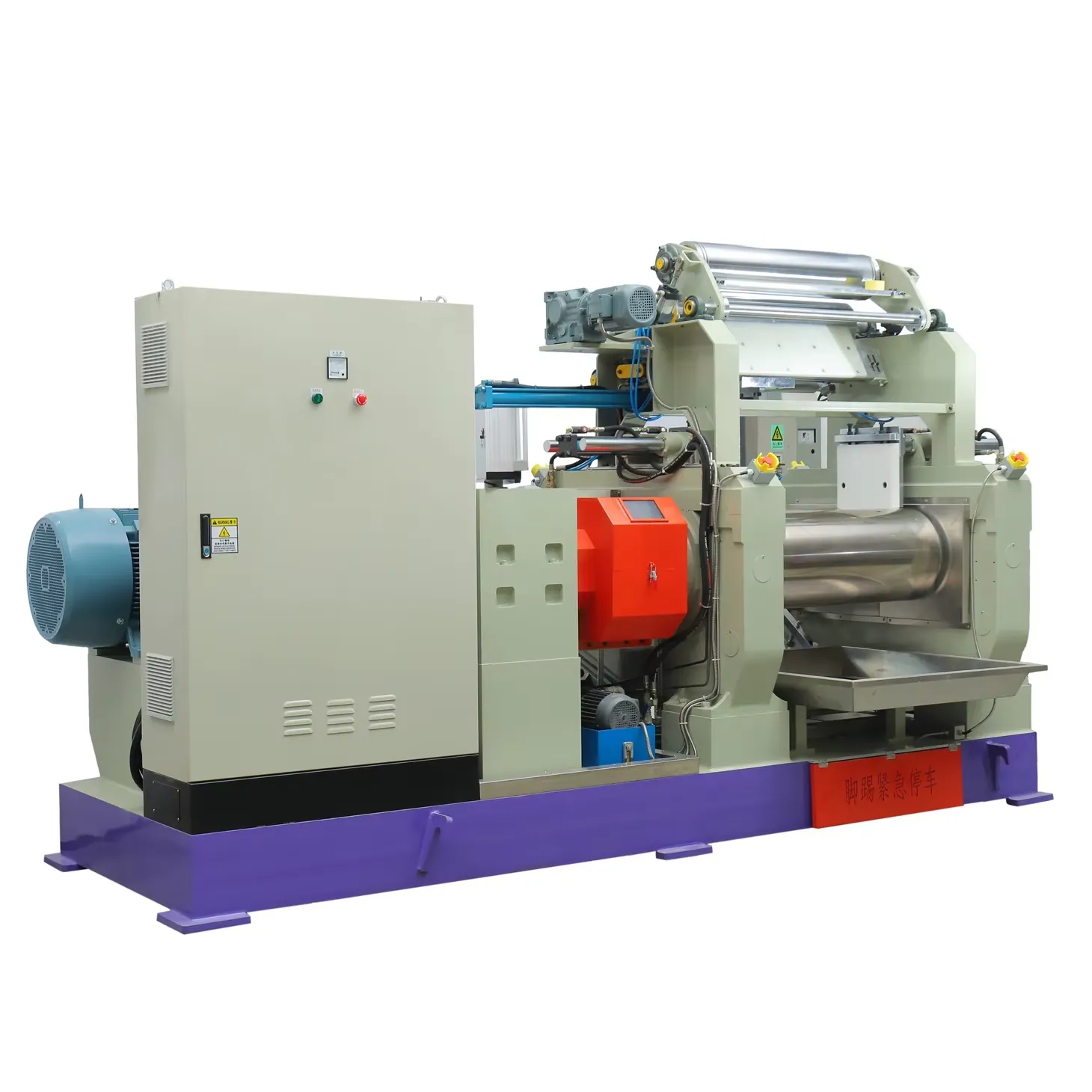
How a 2-Roll Mixing Mill Works: Shear, Friction, and Material Homogenization
Working Principle of an Open Mixing Mill (2-Roll Mill)
The 2 roll mixing mill works by having these two big rollers that spin in opposite directions at different speeds. When we put our raw stuff like rubber or plastics between them, the material gets pulled into the space between the rolls because of friction and sticking forces. What happens next creates some serious stress on the material, something around 15 MPa of shear force plus compression that actually breaks apart those molecular clumps and spreads out whatever additives we need evenly throughout. After going back and forth through the rolls multiple times, the whole thing starts to soften until it becomes one consistent flat sheet. Getting the temperature right matters a lot here. For plastics, we usually heat up the rollers to about 150 degrees Celsius before starting. But when working with rubber, cooling systems are necessary to keep things from setting too early, which would ruin the whole batch.
Role of Shear Force and Friction in Achieving Uniform Material Mixing
In a two roll mill setup, shear forces are what actually make everything blend together properly. When one roll spins faster than the other usually around 1.2 to 1.4 times the speed difference creates this stretching effect across the material as it moves through the gap. For most applications, when we get past about 50 shear rate per second, things start looking pretty good. Carbon black particles for instance will disperse well above 95 percent because those little clusters break apart under all that mechanical stress. Now here's something important though friction builds up heat between the rolls and whatever material is being processed. That heat makes everything runnier so mixing happens better. But watch out if temperatures get too high rubber starts curing way before it should. To avoid this issue manufacturers carefully choose either smooth or grooved surfaces on their rollers while keeping close tabs on temperature controls throughout the whole process.
Key Design Features That Enhance Mixing Efficiency in 2-Roll Mills
Three core innovations improve performance:
- Adjustable Roll Gap: Allows fine-tuning of material thickness (0.5–5 mm) and shear intensity.
- Differential Speed Control: Supports roll speed ratios up to 1.5:1, maximizing shear without overheating.
- Thermal Management Systems: Water-cooled channels maintain roller temperatures within ±2°C of setpoints, crucial for heat-sensitive compounds.
Modern mills use hardened steel rollers with chromium plating, ensuring durability and consistent surface quality over 10,000+ operating hours.
Adjustable Roll Gap Technology: Precision Control for Consistent Mixing Results
What is an adjustable roll gap and why it's critical in mixing mills
The adjustable roll gap is basically the space between those two rolls that operators can control. This lets them tweak how much compression and shear force gets applied when materials are being mixed together. Small changes matter a lot here too. We're talking just half a millimeter difference either way, but that can actually change shear rates by around 30 percent. And guess what? That makes all the difference for getting consistent products out of the process. Plants that have implemented these adjustable systems tend to see about 22 percent fewer rejected batches because of viscosity issues. A recent look at polymer processing from last year backs this up, showing clear benefits across the board for manufacturers who make these adjustments part of their regular operations.
Roll gap positioning mechanisms and their effect on material consistency
Servo-driven actuators or hydraulic systems enable micron-level precision in modern mills. Dual-side positioning aligns each end of the rolls independently, eliminating thickness deviations across the roll face. These advanced calibration systems improve batch-to-batch consistency by 41% compared to manual adjustments.
Real-time dynamic adjustment during operation for process optimization
Integrated IoT sensors allow real-time gap corrections based on material viscosity feedback. This dynamic control prevents over-shearing of temperature-sensitive compounds and compensates for roll wear, contributing to 98% uptime in continuous production environments.
Fixed vs. adjustable roll gaps: Performance comparison in industrial applications
| Metric | Fixed Gap Mills | Adjustable Gap Mills |
|---|---|---|
| Material waste rate | 12-18% | 4-7% |
| Changeover time | 45-90 mins | 8-15 mins |
| Energy consumption | 0.35 kWh/kg | 0.28 kWh/kg |
Data Source: Industrial Mixing Technology Report (2024)
Adjustable systems reduce annual operating costs by $126k per mill under 24/7 operation, thanks to lower energy use and faster grade transitions.
Material Feeding, Recycling, and Process Optimization via Roll Gap Control
Stages of Material Feeding and Initial Breakdown in Open Mixers
Feeding material starts when we put raw rubber, plastics, or composite mixtures into what's called the roll gap. There are different ways to load these materials either by hand or through automation systems. Once inside, the material gets compressed as it passes between two rolls spinning in opposite directions. This creates shear forces that break apart any clumps or agglomerates in the mixture. Operators can adjust how far apart the rolls sit depending on what they need to process. For really tough elastomers, most experienced technicians set the gap pretty tight around 1 to 2 millimeters to get proper fragmentation. But if there are larger additives mixed in, they'll open things up quite a bit to prevent clogging issues down the line.
Recycling Strategies for Uniform Dispersion and Optimal Viscosity Control
Getting the right gap settings is really important when working with scrap materials because it helps find that sweet spot between proper dispersion and manageable viscosity levels. When dealing specifically with silicone rubber products, most manufacturers have found through experience that keeping gaps somewhere around half a millimeter to just over one and a half millimeters works best. This range keeps those filler particles evenly distributed throughout the mixture while preventing any unwanted heat buildup. Adjusting these gaps dynamically as part of the recycling process can cut down on wasted material by roughly twenty percent give or take depending on conditions. What many plant operators do in practice is start with narrower settings to break things down initially, then slowly open them up as processing continues. This approach tends to create much better flow characteristics across different batches of recycled polymers.
Impact of Roll Gap Settings on Reprocessing Efficiency and Output Quality
The way we set those final roll gaps really affects how thick and uniform the material comes out. Even something as tiny as a 0.3 mm difference can actually trap more air inside rubber products, which then makes them weaker when stretched or pulled apart. For working with polyurethane, making small tweaks on the fly during those last few passes helps cut down surface flaws by around 40%. These adjustments get rid of those pesky little voids that nobody wants to see in finished products. And interestingly enough, when dealing with recycled PVC materials, keeping the gap between 1.2 to 1.8 mm reduces strain on motors by about 15%. This means lower electricity bills without sacrificing the quality of how the material flows through the system during processing.
Industrial Benefits of Adjustable Gap Mixing Mills: Flexibility, Efficiency, and Cost Savings
Adaptability across rubber, plastic, and composite processing applications
Adjustable gap mills work well with all sorts of materials ranging from natural rubber that needs careful temperature management to thermoplastic mixes where maintaining consistent shear forces matters a lot. These machines offer around 0.05 mm precision in gap settings, so operators can run silicone rubber at about an 8 to 1 friction ratio one minute and then move right over to carbon fiber reinforced plastics without having to mess with mechanical adjustments. According to a recent study in Material Processing Journal from last year, this kind of setup achieves pretty good batch consistency too, hitting around 95-97% homogeneity most of the time. What makes these systems stand out is how they cut down on cross contamination problems by roughly 40% when compared to older fixed gap models. That's why many companies producing specialty compounds have started switching to adjustable gap technology for their operations.
Reduced downtime and faster changeovers through precise gap control
Automated roll gap adjustment cuts transition times by 60%. Nip settings can be reconfigured in under 90 seconds via HMI interfaces, eliminating manual shimming. Real-time pressure monitoring prevents sudden load spikes during charging, reducing unplanned maintenance by 34% annually. Manufacturers report 22% higher equipment utilization due to these gains.
Energy savings from optimized roll engagement and motor load
Variable-frequency drives paired with adaptive roll gaps reduce power consumption by 18–27% when processing low-viscosity materials. The system automatically lowers motor torque for soft PVC, avoiding the 12–15 kWh overconsumption typical of fixed-gap mills.
Are fully automated roll gap systems worth the investment?
Although automated systems carry a 35–40% higher initial cost, they deliver ROI within 18–24 months in high-volume operations through a 28% reduction in scrap and 50% faster grade changes. For small-batch producers, however, automation may not justify the expense unless annual throughput exceeds approximately 5,000 metric tons.
FAQs on 2-Roll Mixing Mill Technology
What advantages do adjustable roll gaps offer over fixed gaps?
Adjustable roll gaps provide precision control, reducing material waste, speeding up changeovers, and enhancing energy efficiency. They also minimize cross-contamination in different material runs.
How important is shear force in the mixing process?
Shear force is crucial as it helps in breaking down molecular structures and achieving uniform dispersion of materials across the mixture.
Are automated roll gap systems cost-effective for all production scales?
Automated systems provide significant ROI in high-volume scenarios but may not be cost-effective for small-batch operations unless the throughput is substantial.
Table of Contents
- How a 2-Roll Mixing Mill Works: Shear, Friction, and Material Homogenization
- Adjustable Roll Gap Technology: Precision Control for Consistent Mixing Results
- Material Feeding, Recycling, and Process Optimization via Roll Gap Control
- Industrial Benefits of Adjustable Gap Mixing Mills: Flexibility, Efficiency, and Cost Savings
- FAQs on 2-Roll Mixing Mill Technology