
 EN
EN
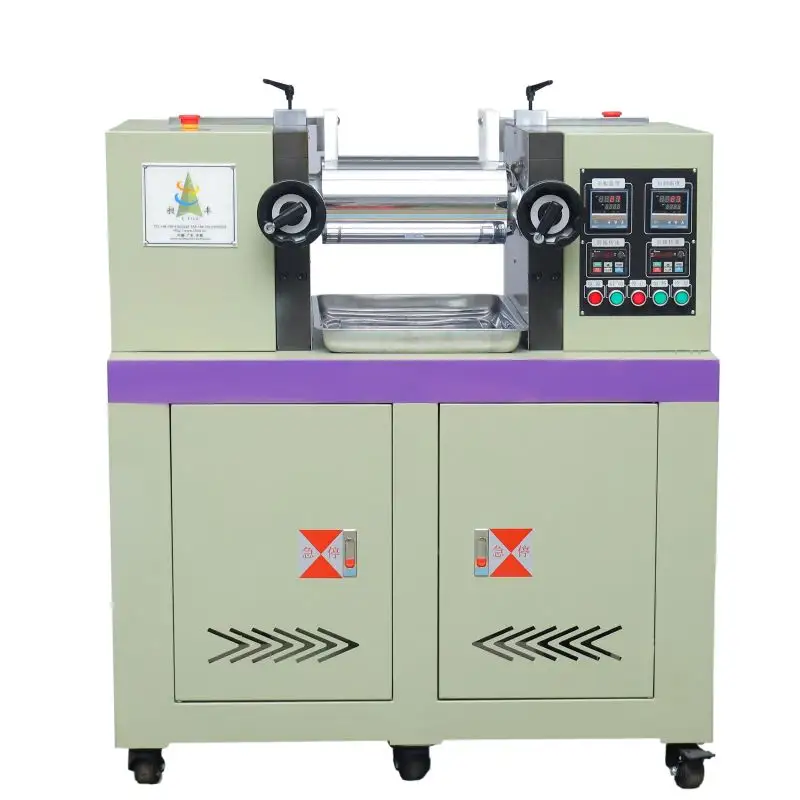
How Mixing Mills Achieve Uniform Plasticization Through Shear and Thermal Control
Modern mixing mills achieve precise plasticization through synchronized control of mechanical shear and thermal energy. This dual-axis approach addresses viscosity variations in raw polymers while ensuring homogeneous integration of additives.
The Role of Shear Force in Polymer Plasticization
Counter-rotating rollers generate controlled shear rates up to 1,500s⁻¹, mechanically breaking polymer chains. This shear-induced molecular alignment reduces entanglement density by 40–60%, enabling uniform plasticizer absorption. Industry data shows optimal shear occurs at 18–22% roller speed differentials, which maximizes chain disentanglement without degrading polymer integrity.
Mechanisms of External and Internal Heating in Mixing Mills
Temperature protocols vary by material:
| Material Type | Heating Method | Typical Range | Thermal Source |
|---|---|---|---|
| Thermoplastics | Roller Preheat | 160–200°C | External Electric |
| Rubbers | Friction Heating | 70–110°C | Mechanical Work |
External heating initiates melting, while internal friction maintains thermal equilibrium during processing. This hybrid method ensures rapid heat transfer without localized overheating, particularly critical for shear-sensitive elastomers.
Optimizing Roller Temperature and Gap for Initial Feed Consistency
A 0.5–2.5mm initial roller gap prevents cold material slippage—the primary cause of uneven mixing. Temperature ramp rates ±5°C/minute avoid premature crosslinking in reactive compounds, preserving processability and final product performance.
Case Study: Advanced Dual-Roller System Design
A leading manufacturer's dual-drive system demonstrates 34% shorter plasticization cycles through:
- Independent roller temperature control (±1.5°C accuracy)
- Real-time gap adjustment during material feed phases
- Tandem cooling zones preventing scorching
This configuration reduced energy-per-kilogram outputs by 18% in high-density polyethylene trials compared to conventional mills, showcasing how precision engineering enhances both efficiency and output quality.
Precision Mixing for Homogeneous Blending of Plastics and Additives
Challenges in Achieving Uniform Additive Dispersion
Getting those additives such as stabilizers, pigments, and flame retardants spread evenly throughout polymer materials continues to be one of the biggest headaches for processors. The problem comes down to several factors working against uniform mixing. Particle sizes can vary quite a bit, there's usually a big difference in density between the base polymer and what gets added to it, plus there are all sorts of electrostatic effects happening too. Take titanium dioxide for instance. When these particles drop below 5 microns, they just love to stick together, forming those annoying dead spots inside mixing equipment where nothing really happens because the shear forces simply can't reach them. Recent research published last year shows how serious this issue actually is. According to their findings, nearly two thirds of all mixing problems seen in recycled HDPE products happen because the additives weren't properly dispersed during the melting process.
Key Factors Affecting Mixing Quality in Open Mill Systems
Three primary factors govern blending effectiveness:
- Rotor Geometry: Helical vs. flat rotors alter shear patterns by 18–22%
- Temperature Gradients: Optimal thermal uniformity (±3°C across the chamber) reduces viscosity mismatches
- Residence Time: 85–92% of additives achieve target dispersion within 90–120 seconds at 65–75 RPM
Modern open mill designs address these variables through tapered roller profiles and segmented heating zones, achieving 99.2% dispersion consistency in polyolefin compounds according to recent trials.
Real-Time Monitoring for Consistent Output in Plastic Granules Mixing
Infrared spectroscopy sensors track additive concentrations every 4.7 seconds during mixing cycles. This data feeds into adaptive control systems that adjust roller gaps within ±0.03mm tolerances. A 2024 implementation study showed real-time monitoring reduced batch rejection rates from 7.1% to 0.8% in ABS production lines while maintaining throughput at 850 kg/hour.
Strategy: Optimizing Mixing Parameters to Ensure Batch-to-Batch Uniformity
Leading manufacturers employ a four-phase optimization protocol:
- Baseline establishment through torque-rheometry analysis
- Shear rate calibration using tracer particle studies
- Thermal profile synchronization with polymer transition points
- Continuous adjustment via machine learning algorithms
This approach has demonstrated 97.5% batch consistency across 18-month production periods in PVC compounding operations, effectively eliminating downstream molding variations caused by mixing inconsistencies.
Energy and Production Efficiency Advancements in Modern Mixing Mill Design
High Energy Consumption in Traditional Mixing Processes
Traditional mixing mills historically required 30–50% more energy than modern systems due to fixed-speed motors operating at peak capacity regardless of material load. This "always-on" approach created unnecessary heat generation and wear, particularly during low-demand phases like pre-blending or cooling cycles.
Balancing Mixing Speed with Performance and Energy Use
Advanced mixing mills now employ variable frequency drives (VFDs) to dynamically align rotor speed with real-time material viscosity and batch size. By reducing motor RPM during low-torque mixing stages, energy consumption drops 22–35% without compromising shear intensity, as demonstrated in polymer compounding trials. Modern systems achieve this balance through closed-loop torque monitoring and AI-driven power allocation.
Case Study: Energy Savings with CFine’s Variable Frequency Drive System
A leading manufacturer’s VFD implementation in nylon compounding reduced energy costs by 35% annually while maintaining ±2% output consistency. Their system uses load-adaptive algorithms to adjust roller gap pressure and motor frequency simultaneously, preventing energy spikes during filler incorporation. Field data shows a 40% reduction in mechanical stress on drive components compared to fixed-speed systems.
Trend: Regenerative Braking and Predictive Maintenance for Reduced Downtime
Emerging models integrate regenerative braking to capture 15–20% of kinetic energy during deceleration, redirecting it to auxiliary systems like barrel heaters. Combined with IoT-enabled predictive maintenance—which analyzes motor vibration patterns to forecast bearing failures 30 days in advance—these innovations reduce unplanned downtime by up to 60% in calendaring applications (2023 Mixing Technology Report).
Improving Rubber Processability and Homogenization in Open Mill Mixing
Poor Processability and Its Impact on Molding Quality
When rubber doesn't process well in open mill mixing operations, it often leads to problems on the surface of finished products such as air bubbles and patchy curing areas. According to research published last year, nearly one third (about 34%) of all issues seen in rubber molding can actually be traced back to poor mixing where materials weren't properly blended together. The problem gets worse when working with thick, high viscosity rubber compounds because they resist shearing forces so much that heat spreads unevenly throughout the mix while additives simply don't distribute properly. What happens next creates real headaches for production lines. Factory managers across different regions have reported losing around 12% of their raw materials each month due to batch rejections caused by these mixing problems, which really adds up over time for any manufacturing operation dealing with large volumes.
Enhancing Compatibility Between Plasticizers and Polymer Matrix
When added to polymers, plasticizers work by reducing those pesky chain entanglements through weaker intermolecular forces. This makes materials flow better during processing, according to recent research published in the Polymer Science Journal last year, which reported improvements around 15 to 20 percent. Getting the right amount of plasticizer into the mix helps bridge the gap between rubber components and various fillers, cutting down blending times by roughly 40%. Most manufacturers aim for somewhere between 5% and 15% plasticizer by weight when making their compounds. Why does this matter? Well balanced ratios create consistent heat transfer throughout the material, something that becomes really important when trying to maintain strong tensile properties after the product has been cured and set.
Case Study: Improved Mixing in Tire Compound Production
A leading tire manufacturer reduced tread hardness variations by 18% after adopting a three-stage open mill mixing protocol:
- Pre-blending additives at 40–50°C
- Shear optimization with 2–3 mm roller gaps
-
Final homogenization at 70–80°C
This approach cut curing time by 22% while achieving ASTM D412-16 elasticity compliance in 98.7% of batches.
Controversy Analysis: Over-Mixing vs. Under-Mixing in Rubber Processing
Under mixing typically leaves around 8 to 12 percent of fillers still clumped together according to Rubber World's 2023 report. On the flip side, when there's too much shear force from over mixing, it actually breaks down those polymer chains which then cuts down on abrasion resistance by about 14%. Modern day mills have started incorporating torque sensors these days so they can keep track of how much energy goes into the mix, usually aiming for somewhere between 3.5 and 4.2 kilowatt hours per ton. This helps find that sweet spot where everything gets properly dispersed without damaging the materials themselves. Take real time viscosity monitoring systems for instance. These babies cut down the chances of over processing by roughly 31% when compared with old fashioned manual controls. Makes sense really, since nobody wants to waste resources or end up with inferior products just because something got mixed too long or not enough.
Applications and Benefits of Mixing Mills in Plastic Molding and Recycling Industries
Stabilizing Properties of Recycled Plastics Through Effective Mixing
The latest mixing mill technology tackles one of the biggest problems with recycled plastics the unpredictable nature of their composition. When stabilizers and compatibilizers get spread evenly throughout the material, it makes all the difference. According to some research from Circular Materials back in 2023, when they ran tests on recycled PET through these high shear mixing systems, they saw about 35% better thermal stability than what comes out of regular blending processes. And this consistency actually translates into better performance metrics too. The melt flow index goes up, which means fewer defects showing up in those long plastic profiles coming off the extrusion line maybe around 28% fewer issues overall. Most top companies have figured out that running materials through two stages works best. First they mix everything together so the base polymer is nice and uniform, then they add stuff like UV inhibitors at just the right moment during processing.
Case Study: Uniform Blending in a PET Recycling Line
According to the 2024 Recycling Efficiency Report, one European recycling plant saw dramatic improvements after installing new mixing technology. Material rejection dropped from around 12 percent down to just 3.8 percent over six months at this facility. What made these results possible? The system features special variable frequency rollers that handle all sorts of inconsistent feedstock densities. As a result, they achieved nearly 98% uniformity when processing about 27 thousand metric tons of PET flakes each year. When testing finished products, there was less than 1% difference in tensile strength between different batches. This kind of consistency is absolutely essential for making containers that meet food safety standards, which explains why manufacturers pay so much attention to these numbers.
Adapting Mixing Speed for Multi-Source Plastic Granules
Modern mixing mills now come with smart torque sensors that can tweak roller speeds on their own during processing of mixed feedstocks with around 15 to 40 percent industrial waste content. The system's ability to optimize in real time stops those pesky clumps from forming in tricky materials such as polypropylene combined with ceramics something that used to cut down tool life by about 17 percent in injection molding operations back in the day. Factory workers have noticed quite a difference too many say switching between ABS and HDPE blends takes roughly 40 percent less time than it did with older fixed speed equipment. Makes sense really these kinds of improvements are becoming standard across manufacturing plants looking to boost efficiency without breaking budgets.
Reducing Waste and Improving Quality in Downstream Molding Operations
When plastic gets properly melted throughout, today's milling equipment cuts down on those annoying molding issues such as sink marks and warpage significantly. Some studies from last year's Plastics Processing Report actually put this reduction at around 52%. Take one major car parts manufacturer for instance they saved nearly 18% on materials costs just by switching out their old gear for new servo controlled systems that adjust gaps automatically during production runs. And there's more good news too. These upgraded machines speed things up quite a bit downstream as well. We're talking about roughly 23% faster cycles when making those ultra thin wall packages which matters a lot because companies need to stick to strict ISO 22000 requirements for food grade products anyway.
FAQ Section
What factors affect the mixing quality in open mill systems?
Rotor geometry, temperature gradients, and residence time are the key factors that govern blending effectiveness in open mill systems.
How do modern mixing mills improve energy efficiency?
Modern mixing mills employ variable frequency drives to adjust rotor speeds according to material viscosity and batch size, reducing energy use by 22–35% without compromising shear intensity.
Why is uniform additive dispersion challenging?
Challenges arise due to variations in particle sizes, density differences between the base polymer and additives, and electrostatic effects, all of which make it difficult for shear forces to uniformly disperse additives.
How is rubber processability improved in mixing mills?
Rubber processability is enhanced by optimizing shear forces and ensuring even distribution of plasticizers, which improves flow and reduces entanglements, leading to better heat transfer and tensile properties.
Table of Contents
- How Mixing Mills Achieve Uniform Plasticization Through Shear and Thermal Control
- Precision Mixing for Homogeneous Blending of Plastics and Additives
- Energy and Production Efficiency Advancements in Modern Mixing Mill Design
- Improving Rubber Processability and Homogenization in Open Mill Mixing
- Applications and Benefits of Mixing Mills in Plastic Molding and Recycling Industries
- FAQ Section