
 EN
EN
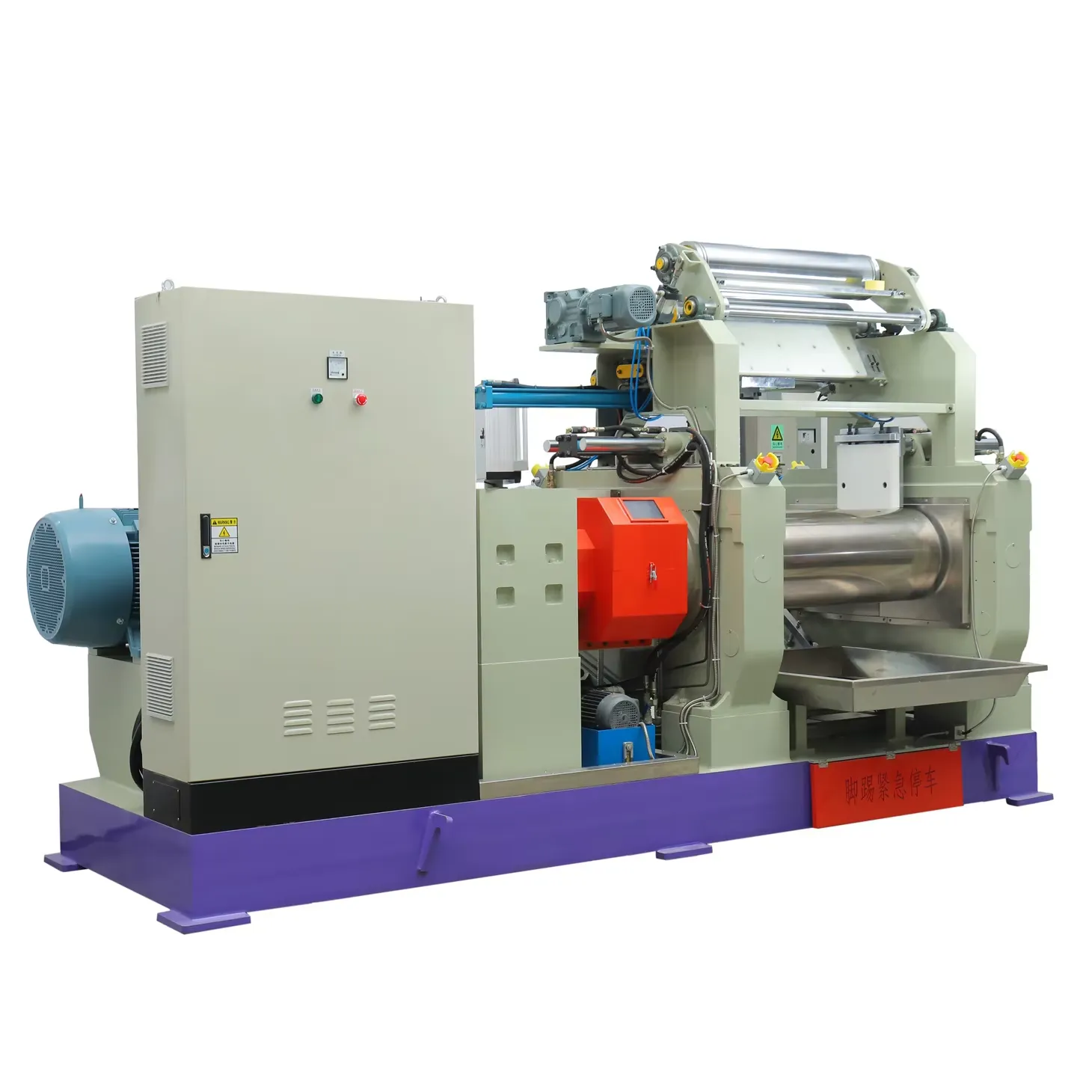
Understanding the Role of the Mixing Mill in Batch Rubber Processing
The significance of mixing mill in rubber manufacturing workflows
Rubber compounding relies heavily on industrial mixing mills. These machines use counter rotating steel rollers that apply just the right amount of shear force to mix raw elastomers with all sorts of additives. The actual mechanical kneading process breaks down those long polymer chains evenly throughout the mixture, which is really important if we want consistent tensile strength across different rubber products such as seals or conveyor belts. When manufacturers optimize their mill operations, they typically see around 18 to 23 percent less material waste than when using older manual techniques. Plus, most modern systems come equipped with built in roll cooling that keeps things running at safe temperatures between about 50 and 70 degrees Celsius. This temperature control helps prevent what's called premature vulcanization, which can ruin entire batches if left unchecked.
How "batch rubber processing" defines production scalability and flexibility
Batch processing gives manufacturers flexibility when adjusting their formulations in batches ranging from about 100 to 500 kilograms. This makes it easier to switch between different specialty compounds like oil resistant NBR or food grade silicone without much downtime. According to Rubber World's latest report from 2023, around seven out of ten small and medium sized rubber plants still rely on batch methods because they require significantly less upfront investment than setting up continuous production lines. The downside though? Energy costs can get pretty high, especially during those early stages where materials are being mixed and worked down into proper consistency before shaping begins. Many plant managers tell us this remains one of their biggest ongoing challenges despite all the advantages batch processing offers.
Core mechanics of "open mill mixing" and its industrial relevance
Open mill mixing achieves thorough blending through three key mechanisms:
- Differential roller speeds (1:1.1 to 1:1.3 ratio) that create folding actions
- Adjustable nip gaps (2–10 mm) for controlled particle size reduction
- Time-regulated passes (typically 6–8 cycles) ensuring complete carbon black dispersion
This process remains ideal for high-viscosity compounds where internal mixer discharge poses challenges. With automated blend samplers providing real-time Mooney viscosity readings, quality checks have been reduced from 30 minutes to under 90 seconds per batch.
Design and Engineering of Industrial Mixing Mills
Engineering Principles Behind "Two-Roll Rubber Mills" for Consistent Shear Distribution
Two roll rubber mills today create consistent shear through carefully controlled roll speeds, typically running at around 1:1.2 to 1:1.4 ratios, while rotating in opposite directions. This setup creates what industry folks call a friction driven wedging effect, which is really important for getting polymers aligned properly and dispersing fillers throughout the material. Some pretty interesting improvements have happened recently too. Manufacturers started hardening roll surfaces to about 60-65 HRC hardness level, and they redesigned how heat spreads across the rolls. These changes made a real difference in the lab tests. The International Rubber Research Board reported last year that dispersion efficiency went up by nearly 18% when working with natural rubber samples. That kind of improvement matters a lot in production settings where consistency counts.
Material Composition and Roll Cooling Systems in Modern "Rubber Mixing Machines"
Rolls are typically made from chromium-molybdenum steel alloys, offering 72% greater thermal fatigue resistance than cast iron. Advanced models incorporate closed-loop water-glycol cooling systems that maintain roll surface temperatures within ±3°C of setpoints. A 2022 Materials Performance study found these systems reduce thermal degradation by 22% during extended mastication cycles.
Adjustable Gap Settings and Torque Control in "Mixing Equipment and Parameters"
Microprocessor-controlled gap adjustments (1–20 mm range) allow operators to tailor shear rates to specific elastomers. Real-time torque monitoring (±2% accuracy) enables dynamic corrections, reducing energy waste by 15% in high-viscosity mixes. Combined with tapered roll ends to prevent edge leakage, this precision ensures ±5% batch consistency across runs.
The Step-by-Step Rubber Mixing Process Using Open Mills
Step-by-Step Breakdown of the "Rubber Mixing Process" Using Industrial Mixing Mills
The mixing process begins by feeding raw elastomer, fillers, and additives into the nip zone between counter-rotating rolls. As the mixing mill draws material in, shear forces initiate mastication and ingredient dispersion. Operators fold and re-feed the compound multiple times to ensure homogeneity—an approach shown in the 2024 Material Processing Report to reduce viscosity variation by 23% compared to single-pass techniques.
Role of Temperature, Residence Time, and Roll Speed in Achieving Uniform Dispersion
Maintaining roll temperatures between 50–70°C prevents scorching while promoting optimal filler integration. A roll speed ratio of 1:1.2–1:1.4 generates staggered shear profiles, and a 40-second residence time per pass has been shown to achieve 98% carbon black dispersion in benchmark tests.
Case Study: Optimizing Mastication and Filler Incorporation in Natural Rubber Batches
A 2023 trial at a European R&D facility demonstrated that setting roll gaps to 2–4 mm during mastication reduced energy use by 18%, while maintaining tensile strength above 28 MPa. By implementing four folding cycles at 55°C, operators achieved uniform silica distribution with less than 0.5% variance.
Common Defects in Batch Output and Corrective Operator Interventions
| Defect Type | Root Cause | Corrective Action |
|---|---|---|
| Uneven Dispersion | Insufficient Folding | Increase pass count by +2 cycles |
| Scorching | Roll Temp >70°C | Activate emergency cooling protocols |
| Air Entrapment | High Batch Loading Rate | Reduce feed volume by 15–20% |
Real-time torque monitoring helps detect instability; deviations exceeding 8% prompt immediate roll-speed adjustments to restore shear balance.
Performance Monitoring and Process Control in Mixing Operations
Key Performance Indicators for Evaluating Industrial Mixing Equipment Efficiency
Efficiency is measured through three primary KPIs: energy consumption per batch (kWh/kg), cycle time variance (±%), and compound uniformity (via Mooney viscosity or dispersion index). Facilities achieving å2.5% batch-to-batch viscosity deviation report 12% lower material waste (Rubber World, 2022). Reducing energy use by 15 kWh/ton saves approximately $18,000 annually for mid-sized plants.
Monitoring Energy Consumption, Batch Cycle Time, and Compound Consistency
IoT-enabled load cells and infrared spectrometers monitor critical parameters every three seconds. Real-time dashboards alert operators to:
- Roll temperatures deviating beyond ±5°C of setpoint
- Torque spikes exceeding 20% above baseline
- Cycle durations extending past ±8% of target
Facilities using this multi-parameter monitoring system report a 34% reduction in scrap rates versus manual inspection methods.
Data-Driven Adjustments Based on Real-Time Feedback from Mixing Sensors
These days, self optimizing algorithms tweak roll gaps and apply just the right amount of nip pressure based on real time viscosity readings from the production line. A recent benchmark study looking at rubber processing in 2023 found that when plants implement these adaptive control systems, they see about an 18% drop in defects related to material consistency issues. The machine learning models behind this technology have been trained across well over 50 thousand batches of material. What's impressive is how accurate they get at predicting the best mastication times for different compounds, hitting around 94% accuracy rate. This means companies spend roughly 40% less time developing new product formulas compared to traditional methods, which saves both money and resources in the long run.
Open Mill Mixing vs. Internal Mixers: Applications and Trade-offs
When to choose "industrial mixing mills" over continuous mixers for specialty compounds
When accuracy takes precedence over how fast things get done, industrial mixing mills become the go to option. The open setup lets operators actually see what's happening inside and jump in manually if needed, which is super important when working with materials that can't handle too much heat or when testing out new formulas. Internal mixers do run quicker cycles, around 30 to 45 minutes per batch compared to just 15 to 20 minutes for some other systems, but they come with sealed chambers that make it tough to check progress halfway through. That's why two roll mills still hold their ground in labs where people need to fine tune conductive elastomers or work on medical grade silicones that require constant adjustments during production.
Flexibility in small-batch customization using "rubber mixing mill" setups
With an open design, researchers can actually adjust shear profiles manually through folding techniques something most automated mixers just cant match when working at R&D scales. Many labs focused on creating things like carbon nanotube reinforced tires or those tricky shape memory polymers rely on this kind of direct control to get dispersion right without having to spend big bucks on new equipment. The improved temperature control around plus or minus 1 degree Celsius makes all the difference for specialized stuff like aerospace sealants too. Weve seen this in several recent tests looking at how materials behave under different conditions.
Trend: Resurgence of open mills in niche elastomer R&D facilities
According to recent surveys from 2023, around 68% of elastomer research facilities have brought back open mills for their material development work, mainly because operators give much better feedback when working with graphene materials. The basic design of these machines makes it easy to switch between different roll textures really quickly. Some labs need smooth surfaces for making high quality optical silicone products, while others prefer the grooved rolls needed for composite materials reinforced with fibers. And this trend is accelerating as sensors get cheaper to install these days. We're seeing prices drop down to about $740 per unit for those real time viscosity monitoring systems now. As a result, most forward thinking polymer researchers consider two roll mills absolutely necessary equipment for any modern lab working on cutting edge materials.
FAQ Section
What are the main advantages of using mixing mills in rubber manufacturing?
Mixing mills provide consistent shear force, reducing material waste by 18-23% compared to manual techniques. They offer flexibility in batch processing and help prevent premature vulcanization.
Why is batch processing preferred in some rubber manufacturing plants?
Batch processing allows manufacturers to easily adjust formulations and switch between specialty compounds, requiring less upfront investment compared to continuous production lines.
How does open mill mixing differ from internal mixers?
Open mill mixing offers manual control, ideal for specialty compounds that require careful handling and adjustment, while internal mixers provide faster cycle times but with less flexibility for in-process adjustments.
What role do sensors play in modern mixing mills?
Sensors provide real-time monitoring of critical parameters, including viscosity and temperature, enabling data-driven adjustments and reducing defects related to material consistency issues.
Table of Contents
- Understanding the Role of the Mixing Mill in Batch Rubber Processing
- Design and Engineering of Industrial Mixing Mills
- Engineering Principles Behind "Two-Roll Rubber Mills" for Consistent Shear Distribution
- Material Composition and Roll Cooling Systems in Modern "Rubber Mixing Machines"
- Adjustable Gap Settings and Torque Control in "Mixing Equipment and Parameters"
-
The Step-by-Step Rubber Mixing Process Using Open Mills
- Step-by-Step Breakdown of the "Rubber Mixing Process" Using Industrial Mixing Mills
- Role of Temperature, Residence Time, and Roll Speed in Achieving Uniform Dispersion
- Case Study: Optimizing Mastication and Filler Incorporation in Natural Rubber Batches
- Common Defects in Batch Output and Corrective Operator Interventions
- Performance Monitoring and Process Control in Mixing Operations
- Open Mill Mixing vs. Internal Mixers: Applications and Trade-offs
- FAQ Section