
 EN
EN
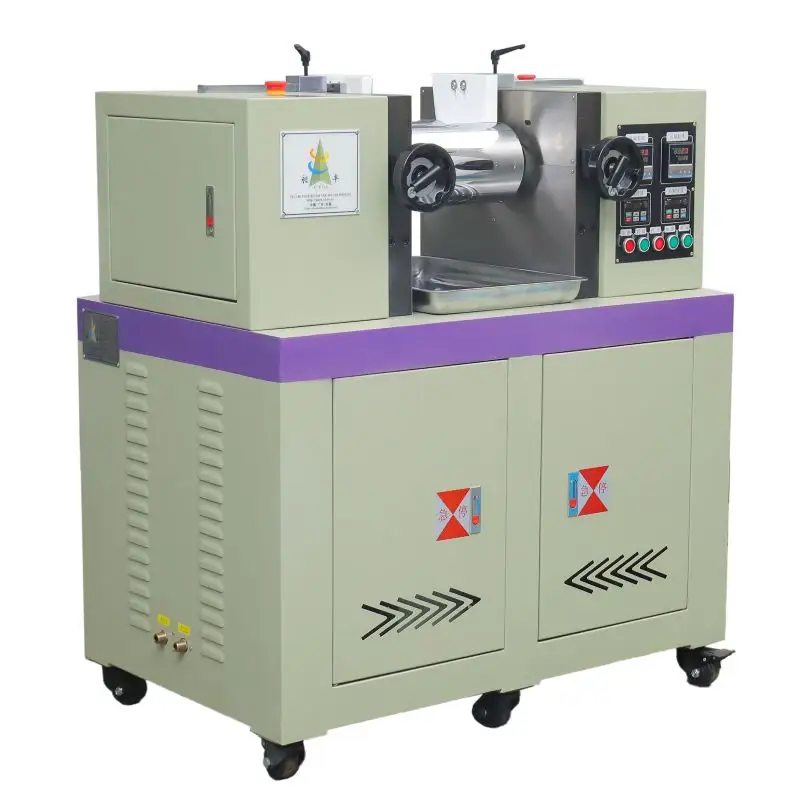
Working Principle of Two-Roll Mixing Mills: Shearing Action and Material Behavior
Material Behavior Under Dual Roller Compression
When raw materials get fed into the space between those two rotating rollers going in opposite directions, they experience both friction and sticking forces that basically drag everything into what we call the compression area. Now here's something interesting about how these machines work - most of them run with a slight speed difference between the rollers, usually somewhere around 1.2 to 1.4 times faster on one side than the other. This creates all sorts of internal stresses within the material as it gets stretched out and flattened down. What happens next is pretty neat for polymers and rubber compounds specifically. They start changing from their original grainy or powder form into actual solid sheets. This initial mixing process helps distribute components throughout the material before the real kneading action starts taking place later on in the manufacturing line.
Role of Shearing and Kneading Forces in Homogenization
The shearing forces we see in modern mills can reach around 50 kN per square meter, which effectively breaks apart those stubborn additive clusters. At the same time, the kneading action works by folding different material layers together so particles get spread out evenly throughout the mix. These two processes working together help fix those pesky viscosity differences when combining base polymers with common fillers such as carbon black or silica. Recent research from 2023 on mixing efficiency showed something pretty interesting too. When manufacturers fine tune their shear rates just right, they actually achieve about a third better dispersion homogeneity than what's possible with standard roll compaction methods alone.
Case Study: Breakdown of Agglomerates in Polymer Compounds
A leading manufacturer achieved 98.5% dispersion efficiency in silica-reinforced EPDM by maintaining a 2 mm gap at 65°C. Agglomerate size dropped from 120 μm to under 15 μm within eight mixing cycles, demonstrating how targeted shear profiles overcome particle clustering. Post-mill testing showed a 22% increase in tensile strength.
Trend: Advancements in High-Shear Mixing for Viscous Materials
New models integrate variable-frequency drives allowing 0.1 RPM adjustments, enabling precise control over shear gradients. Real-time viscosity sensors trigger automatic gap adjustments with ±0.05 mm accuracy—critical for heat-sensitive compounds like fluoropolymers. These innovations support continuous mixing workflows that reduce energy consumption by 18% while handling viscosities up to 12,000 Pa·s.
Core Components of a Two-Roll Mixing Mill: Rollers, Drive System, and Pressure Control
Roller Design and Material Composition for Durability
Rollers are typically made from chilled cast iron or chromium-plated steel alloys for high wear resistance. A 2023 analysis found hardened surfaces retain dimensional stability after 5,000+ operational hours under abrasive conditions. Advanced models feature replaceable wear plates at contact points, reducing long-term maintenance costs by 32% compared to monolithic designs.
Drive System Efficiency and Torque Delivery
A precisely calibrated drive system ensures consistent torque across variable viscosities. Synchronous AC motors paired with helical gear reducers achieve energy efficiencies up to 94% in continuous operations. Improper backlash compensation can increase energy use by 20%, highlighting the need for servo-controlled tensioning mechanisms.
Pressure Regulation for Consistent Mixing Performance
Modern mills use closed-loop hydraulic systems capable of maintaining ±0.5% force variance across roller lengths. This precision prevents "edge bleeding," where additives migrate toward low-pressure zones. Embedded load cells enable real-time pressure mapping, allowing dynamic adjustments for materials such as silicone rubbers (15–25 MPa) and thermoplastic elastomers (30–40 MPa), ensuring batch uniformity.
Temperature Management in Two-Roll Mills for Stable Mixing
Impact of Temperature on Dispersion Quality
Getting temperature control just right makes all the difference when it comes to how additives spread out and how polymers behave during processing. If things get too hot or cold, say more than 5 degrees off the target range, we start seeing problems with how evenly materials mix together, sometimes as bad as a 40% drop in uniformity. Take natural rubber for instance. When temps go over 70 degrees Celsius during plastication, the shearing action gets less effective. But if it's too cool, under 50 degrees actually, the material becomes much thicker, making it really hard to work those fillers into the mix properly. That's why most plants invest in systems that can track conditions constantly. Keeping everything flowing smoothly through those sweet spots where rheology works best isn't optional anymore these days.
Cooling Systems to Prevent Premature Curing
Cooling systems designed with internal channels in the rollers and PID controls for water circulation handle friction heat pretty well in industrial settings. Most dual stage configurations keep roller temps around 55 to 60 degrees Celsius when working with carbon black materials, which stops those pesky crosslinks from forming too early. The really advanced models come equipped with temperature sensors that tweak coolant flow almost instantly, usually within two seconds or so, maintaining stability within plus or minus 1.5 degrees during intense mixing operations. This kind of tight temperature control makes all the difference for sensitive materials such as silicone rubber compounds that can degrade if exposed to excessive heat.
Balancing Heat Dissipation: Risks of Over-Cooling vs. Overheating
| Over-Cooling Risks | Overheating Consequences |
|---|---|
| 18–22% higher energy use | Accelerated polymer degradation |
| 30–50% viscosity variance | 12–15% tensile strength loss |
| 15–20-minute cycle delays | Premature vulcanization initiation |
Operators must align cooling rates with material-specific heat profiles. A 2023 survey found 68% of mixing defects stem from mismatched cooling capacity and shear input. Optimal setups balance convective cooling with adjustable roller speeds to sustain 85–90% thermal efficiency across batches.
Optimizing Roller Settings: Speed, Gap, and Pressure Control
Influence of Roll Gap and Speed on Material Flow Dynamics
Adjustments as small as 0.1 mm can alter shear stress distribution by up to 40% in polymer compounds. Wider gaps reduce localized heating but risk incomplete dispersion; narrower settings raise power consumption by 18–22%. A 2024 Compaction Technology Report found synchronized speed control improves material homogeneity by 33% in high-viscosity elastomers.
Strategy: Step-by-Step Calibration of Mixing Parameters
- Initial alignment: Parallel roller positioning within ±0.05 mm tolerance
- Baseline testing: 15-minute trial runs at 20%, 50%, and 80% target speeds
-
Gap optimization: Progressive 0.25 mm reductions until peak dispersion efficiency
This phased approach reduces trial batch waste by 25% compared to conventional methods.
Trend: Automated Feedback Systems for Real-Time Adjustments
Advanced mills now integrate infrared viscosity sensors and AI-driven pressure regulators. These systems adjust roller gaps within 0.8 seconds of detecting changes in filler concentration, maintaining ±2% viscosity tolerance during continuous runs.
Case Study: Precision Calibration at Guangdong CFine Technology Co., Ltd.
The manufacturer reduced material waste by 25% and saved 18% in energy through:
- Dual-laser gap monitoring at 400 Hz frequency
- Hydraulic pressure stabilization within 0.7 bar ranges
- Predictive wear compensation algorithms
Post-calibration results showed 99.1% additive uniformity in silicone rubber compounds.
Applications in Plastics and Rubber: Achieving Additive Uniformity
Challenges in Dispersing Additives in Polymer Matrices
Dispersing additives such as reinforcing fillers, stabilizers, and colorants requires precise control of shear and temperature. Carbon black improves mechanical strength by 40–60% but increases viscosity, slowing processing by 10–20%. Uneven distribution contributes to weak spots—34% of rubber product failures in 2022 were linked to poor additive dispersion.
| Additive Type | Mechanical Strength Gain | Processing Speed Impact | Temperature Stability Boost |
|---|---|---|---|
| Reinforcing Fillers | +40-60% | -10-20% | +30-50°C |
| Stabilizers | No Change | +5-10% | +80-120°C |
| Colorants | No Change | +10-20% | +20-40°C |
Balancing additive concentrations with shear optimization helps prevent agglomerate formation, especially in high-viscosity elastomers like silicone rubber.
Continuous Mixing Processes for High-Viscosity Materials
Two roll mills can maintain shear rates between roughly 50 to 120 seconds inverse during continuous operations, which is really important when working with thick substances like EPDM rubber. Recent tests from 2024 showed that tweaking the space between rollers cut down on energy usage around 18 percent while making the material mix much more evenly across the board, about 30% better actually, in the production of car sealants. When manufacturers install systems that monitor viscosity in real time, these setups will adjust roller speeds on their own, preventing those sudden temperature jumps that might cause thermosetting resins to start curing too early. This kind of control matters a lot for things requiring tight tolerances, think medical grade silicone tubes where even small inconsistencies just won't do.
FAQ
What are the common materials used in roller construction?
Rollers are commonly made from chilled cast iron or chromium-plated steel alloys due to their high wear resistance.
Why is temperature control important in two-roll mills?
Temperature control is crucial because unrealistic temperature fluctuations can lead to uneven mixing and processing inefficiencies.
How do modern mills ensure consistent mixing performance?
Modern mills use closed-loop hydraulic systems that maintain precision in force variance across rollers, preventing additive migration to low-pressure zones.
Table of Contents
- Working Principle of Two-Roll Mixing Mills: Shearing Action and Material Behavior
- Core Components of a Two-Roll Mixing Mill: Rollers, Drive System, and Pressure Control
- Temperature Management in Two-Roll Mills for Stable Mixing
- Optimizing Roller Settings: Speed, Gap, and Pressure Control
- Applications in Plastics and Rubber: Achieving Additive Uniformity
- FAQ