
 EN
EN
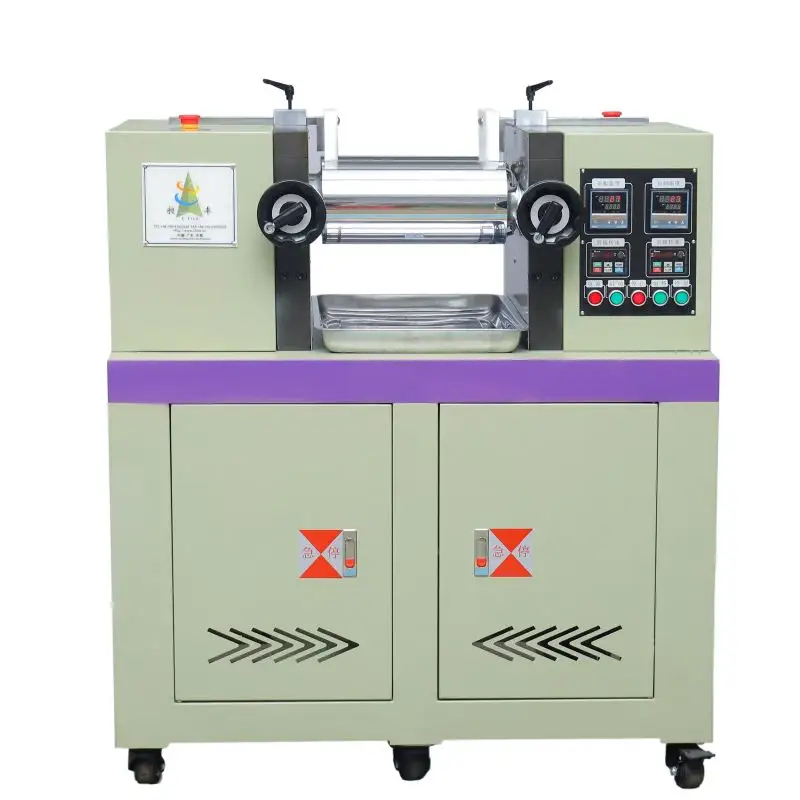
Understanding Open Mixing Mill and Its Role in Rubber Processing
What is Open Mill Mixing and How It Supports Rubber Compounding
The open mill mixing technique remains one of the basic methods used in rubber processing. Basically, it involves combining raw rubber materials with various additives on what's called a two-roll mill setup. The machine has these big parallel rollers spinning against each other, creating those powerful shearing forces needed to actually break apart the long polymer chains during the mastication process. What happens next? Well, the molecular weight gets reduced while plasticity increases, which makes it much easier to evenly distribute those important fillers such as carbon black or even silica throughout the mixture. Compared to closed system approaches, open mills give operators something valuable they can't always get elsewhere real time visibility into what's happening plus the ability to make hands-on adjustments whenever necessary. That's why many manufacturers still prefer them especially when working with smaller batches or developing complicated formulas that demand close attention to detail.
The Role of the Two-Roll Mill in Rubber Plasticization and Mastication
What makes a two roll mill so effective is the way it adjusts speeds between the rolls, usually around a 1:1.2 to 1:1.4 friction ratio. This creates just the right amount of shear force as materials pass through. When rubber goes through the gap between the rolls, the mechanical friction actually generates heat. This heat softens the rubber while also lining up those polymer chains, which helps improve how well they'll crosslink later during vulcanization. The whole process tackles the problem of raw rubber being too thick and sticky, turning it into something that can be worked with for things like calendering or extrusion. Most newer mills come equipped with temperature controlled rollers these days. This feature keeps everything running smoothly without risking premature scorching, something plant managers definitely want to avoid when production schedules are tight.
Key Differences Between Open Mixing Mills and Other Mixing Equipment
| Feature | Open Mixing Mill | Internal Mixers (e.g., Banbury) |
|---|---|---|
| Visibility | Full material access | Closed chamber |
| Shear Control | Manual via gap settings | Automated rotor speed |
| Batch Flexibility | 5–50 kg | 100–500 kg |
| Skill Dependency | High operator expertise | Programmable automation |
Compared to internal mixers, open mills provide much more flexibility since they let technicians tweak recipes while the process is still running. This makes them really valuable when developing new products or working with special compound formulations. On the downside though, these machines need experienced personnel to operate properly and take considerably longer to complete cycles, roughly 25 to 35 percent behind what Banbury mixers can achieve. That means production volumes just don't match up for mass manufacturing operations. Recent improvements have changed things somewhat though. New tungsten carbide coatings on the rollers allow open mills to tackle those super abrasive materials that used to require only closed system equipment. Manufacturers are starting to see this as a real game changer for certain applications where both quality and cost matter.
Core Principles for Optimal Performance of a Mixing Mill
Roll Speed and Friction Ratio: Balancing Shear and Throughput
Optimal mixing requires balancing roll speed and friction ratios. A 1:1.2–1:1.4 ratio typically provides sufficient shear for homogenization without excessive heat buildup. Too high a ratio risks overheating sensitive elastomers; too low compromises filler dispersion. Maintaining this balance ensures efficient processing while preserving compound integrity.
Optimal Roller Temperature Control for Consistent Mixing Results
Temperature deviations exceeding ±7°C between rollers can reduce rubber plasticity by 18–22%. Modern mills use closed-loop cooling systems to maintain operating temperatures between 50–80°C, stabilizing viscosity during mastication. Research shows that achieving ±3°C thermal uniformity improves filler dispersion efficiency by 34%, underscoring the importance of precision temperature management.
Adjusting Gap Settings and Managing Material Accumulation
The roll gap settings between 0.5 and 3 millimeters have a major impact on how long materials stay in the system and the amount of shear they experience. When the gaps are narrow, there's more mechanical action happening which works well for stubborn compounds that need extra processing power. But when dealing with heat sensitive materials, wider gaps tend to be better since they minimize thermal stress. Operators typically run cross blending sessions roughly every six to eight minutes to keep things moving properly through the system. This regular mixing has been found to cut down batch inconsistencies by around 29 percent according to industry reports. These days, many facilities are installing real time pressure monitoring systems that can actually adjust the roll gaps automatically during important steps such as when adding fillers into the mix.
Step-by-Step Operation of an Open Mixing Mill for Reliable Results
Pre-operation checks and safety precautions in rubber processing on open mixing mill
Before operation, verify roller alignment, temperature calibration, and lubrication levels. A 2023 safety audit found that 78% of equipment incidents stemmed from inadequate pre-use inspections. Essential checks include:
- Confirming emergency stop functionality
- Inspecting nip guards and safety curtains
- Ensuring thermal sensors are operational
- Enforcing proper personal protective equipment (PPE) protocols
Adherence to industry safety standards is crucial, particularly lockout-tagout procedures during maintenance or gap adjustments.
Initiating rubber mastication process and feeding raw materials
Begin with clean rolls heated to 50–60°C for natural rubber. Feed the rubber gradually into the bite zone at consistent roll speeds. Proper mastication reduces molecular weight by 30–40%, enhancing additive integration. Monitor the formation of a continuous band around the front roll—an indicator of effective plasticization.
Controlled addition of fillers and curatives during mixing sequence
Add carbon black and process oils in stages, ensuring full dispersion before introducing sulfur or accelerators. For a typical 10 kg batch, allow 3–5 minutes for filler incorporation. Maintain a 10–15°C temperature differential between rolls to guide material flow and avoid premature vulcanization.
Ensuring homogenization through proper mixing time and folding techniques
| Mixing Stage | Duration | Key Action |
|---|---|---|
| Breakdown | 3–4 min | Cross-blending |
| Filler Mix | 6–8 min | 8-folding pattern |
| Finalizing | 2–3 min | End-rolling |
Perform 90-degree sheet folds every 2 minutes to eliminate concentration gradients. Studies show this technique improves tensile strength consistency by 18% compared to unidirectional mixing.
Discharge, cooling, and post-processing steps in rubber compounding
Cut the homogenized sheet diagonally and cool in water baths maintained at 20–25°C. Allow 30 minutes for stabilization before measuring Mooney viscosity. Post-mixing analysis should confirm viscosity variations remain under ±3% across the batch—a key threshold for downstream processes like extrusion and molding.
Critical Factors Affecting Mixing Quality in Open Mill Operations
Impact of Roller Temperature Fluctuations on Batch Consistency
Precise temperature control maintains uniform viscosity and prevents scorching. Advanced mills maintain roller temperatures within ±2°C of setpoints, avoiding crosslinking irregularities that can reduce yield by up to 15% under uncontrolled conditions. Sensor-guided cooling systems automatically adjust water flow to stabilize thermal conditions during mastication.
Influence of Roll Gap Precision on Dispersion Efficiency
The roll gap governs shear force intensity. A deviation as small as 0.1 mm can reduce filler dispersion uniformity by 22%. Combined with optimal friction ratios (1:1.2–1:1.4), precise gap control is essential for producing homogeneous rubber compounds.
Material Accumulation Effects and Strategies to Minimize Dead Zones
Accumulation at roller edges leads to uneven stress distribution and poor mixing. Effective strategies include:
- Staggered folding every 3–4 passes
- Incremental roll gap adjustments
- Limiting accumulation to 20–30% between batches
These practices help maintain consistent shear application and minimize dead zones.
Fixed Parameters vs. Adaptive Control in Industrial Mixing Applications
Traditional mills rely on preset speeds and gaps, but modern adaptive systems dynamically adjust friction ratios based on real-time viscosity measurements. This approach reduces hardness variations by 40% compared to manual methods, significantly improving batch consistency and reducing rework.
Advancements and Future Trends in Mixing Mill Technology
Integration of digital controls for temperature and roll settings
Modern mixing mills feature digital control systems that maintain roller temperatures within ±1.5°C of setpoints, ensuring stable viscosity during compounding. Servo-driven roll gap adjustments achieve 0.01 mm precision, reducing manual calibration errors by 42%. These systems allow replication of proven parameters across batches, enhancing consistency in cross-link density and filler dispersion.
Energy-efficient designs enhancing simple operation and reliability
Recent innovations deliver 30–40% energy savings through:
- Variable-frequency drives that optimize motor torque based on material load
- Insulated roller designs retaining 15% more thermal energy
- Heat recovery systems repurposing waste heat for feedstock pre-heating
A 2024 case study demonstrated these upgrades reduced annual operating costs by $18,200 per unit while maintaining 99.3% uptime.
Future outlook: Smart sensors and predictive maintenance in mixing equipment
The latest IoT sensors are tracking no fewer than 14 different operational factors right now, things like how much the bearings vibrate (keeping within a 5 micrometer range is critical) and what condition the gearbox oil actually is in. These smart systems run their machine learning stuff on all this data, which helps spot potential problems anywhere from three days to four full days before they happen. That kind of heads-up has cut down unexpected shutdowns by almost two thirds according to the numbers. Companies that got started early with these technologies say they've seen about a 22 percent boost in how well their preventive maintenance works. The AI takes care of fine tuning things automatically too, adjusting roller speeds and feed rates so everything runs at maximum efficiency without needing constant human oversight.
FAQ
What is open mill mixing?
Open mill mixing is a technique used in rubber processing where raw rubber is masticated and mixed with additives using a two-roll mill to achieve desired plasticity and compound distribution.
Why is temperature control important in open mill mixing?
Temperature control is essential to maintain consistent viscosity and avoid scorching. Precise roller temperatures improve filler dispersion and prevent crosslinking irregularities.
How does a two-roll mill function in rubber plasticization?
In a two-roll mill, friction between the rolls generates necessary shear forces and heat for softening rubber and aligning polymer chains, enhancing plasticization.
What are the benefits of using open mixing mills over internal mixers?
Open mixing mills offer real-time process visibility, manual adjustment capabilities, and flexibility for small batch or complex compound development.
Table of Contents
- Understanding Open Mixing Mill and Its Role in Rubber Processing
- Core Principles for Optimal Performance of a Mixing Mill
-
Step-by-Step Operation of an Open Mixing Mill for Reliable Results
- Pre-operation checks and safety precautions in rubber processing on open mixing mill
- Initiating rubber mastication process and feeding raw materials
- Controlled addition of fillers and curatives during mixing sequence
- Ensuring homogenization through proper mixing time and folding techniques
- Discharge, cooling, and post-processing steps in rubber compounding
- Critical Factors Affecting Mixing Quality in Open Mill Operations
- Impact of Roller Temperature Fluctuations on Batch Consistency
- Influence of Roll Gap Precision on Dispersion Efficiency
- Material Accumulation Effects and Strategies to Minimize Dead Zones
- Fixed Parameters vs. Adaptive Control in Industrial Mixing Applications
- Advancements and Future Trends in Mixing Mill Technology
- FAQ